Cathy really liked David. No—she really liked him. It had started the way most things did at Central High in the mid-1970s—quietly, without much warning. She had first noticed him weeks earlier in the hallways, those long, echoing corridors lined with gray lockers and the faint smell of floor wax that never quite went away.
Even though he was quiet and unasumming, a lot of people knew David. If you didn’t know him by name, you knew him by reputation. He played football. David was a fullback—number 36. Not flashy or anything like that. He wasn’t getting his name called out over the loudspeaker every Friday night. He mostly blocked, and did he ever hit hard, clearing paths for the tailback.
People went down when David hit them. Last week, though, Coach had let him carry the ball a couple of times, and he’d broken free for a twenty-yard touchdown that had the bleachers at Markley Field on their feet. Still, most of the time, his job was to block, to protect, to make things happen for someone else.
Cathy admired that. She officially met him one day between second and third period. She’d been leaning against the lockers with Terri, talking about a math quiz and whether or not the cafeteria would have sloppy joes again, when David walked up. He greeted Terri first—everyone knew Terri—then looked over at Cathy and smiled. Not a quick smile. Not a polite one. A real smile. Terri introduced them, and Cathy felt her chest tighten just a little. When she caught the sparkle in his eyes, something settled into place.
From that moment on, she noticed everything about him—the way he walked with an easy confidence, the way his voice stayed calm, the way he always looked people in the eye when he spoke. After that, whenever they passed in the halls, David always smiled and said hello. Sometimes it was just a nod. Sometimes a soft “Hey, Cathy.” He never stopped to talk, though. Not once. Still, those brief moments were enough to carry her through the day.
Last week, she spotted him in the lunchroom. He was sitting with a couple of other football players, and another guy she had seen around, but didn’t know. They laughed loud, and traded jokes as they ate their lunch. Cathy sat across the room with Katrina and Valerie, pretending to eat her fries while stealing glances his way. Cathy wished he would turn around and see her. He didn’t.
She finally told Katrina and Valerie everything after school one afternoon as they walked down 4th Avenue, leaves crunching under their shoes. The air was cool, the sky already starting to darken earlier now that fall had settled in.
“I think I really like him,” Cathy admitted.
Katrina stopped walking and turned to her.
“Then you need to do something. You need to let him know.”
Homecoming was next Friday. The gym would be decorated with crepe paper and streamers, the band would play slow songs that made everyone sway too close, and couples would pose for Polaroids in front of handmade banners.
“You should ask him to Homecoming,” Valerie said.
Cathy laughed nervously.
“No way.”
But they didn’t let it go. They talked her into it inch by inch, until finally Cathy relented.
Then Katrina came up with a bright idea.
“And you know what you should do? She said. “Give him a flower. A rose. A red rose. You need to let him know you mean business.”
Cathy smiled at the thought of it. It made her nervous to even think about doing something like that, but she overcame her nervousness and bought one. Just one. A red one. Red meant love. All the girls knew that, even if the guys probably didn’t.
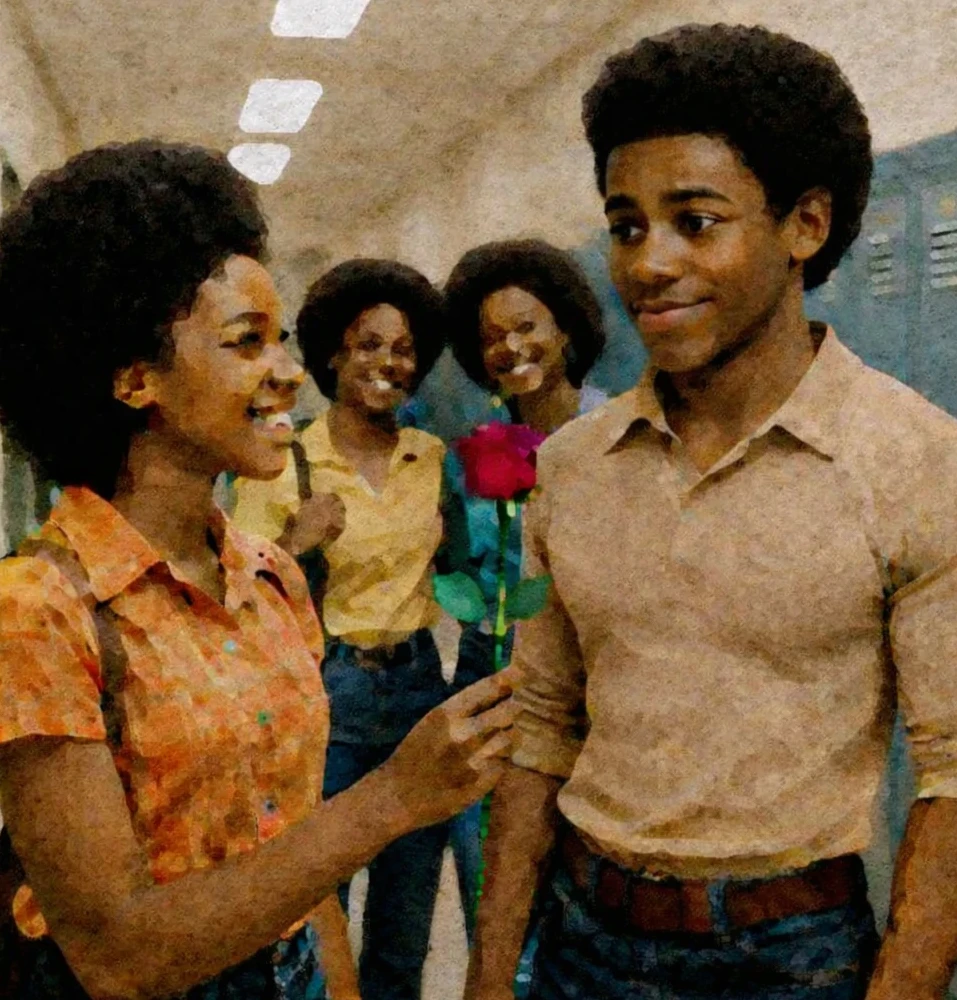
The next morning, Cathy arrived at school early, with of course, Katrina and Valerie, the rose wrapped carefully in tissue paper. They planned to tuck it safely into her locker before the building filled up.
The halls were quiet, the hum of fluorescent lights the only sound. Then, unexpectedly, David appeared at the far end of the hallway, books tucked under his arm.
“Hey, Y’all,” he said, smiling.
Her heart jumped. Ok. Here it goes, she thought to herself. At first she thought she was going to chicken out, but she knew she better do this now. Who knew if she would get another chance. She took a deep breath, and asked him if he could come over to her locker—she had something she wanted to give him.
Valerie and Katrina stayed back. This was going to be Cathy’s show.
David raised an eyebrow, curious, but nodded.
“Sure.”
She opened her locker and pulled out the rose, her hands shaking just a little.
“This is for you.”
“For me?” David asked, surprised, but clearly pleased.
“Yep. For you.”
Then she took another deep breath.
“Are you going to the homecoming dance?”
He shrugged. “Haven’t really thought about it. I’ve just sort of been thinking about the game.”
“So, you haven’t asked anyone.”
David shook his head. “Nope.”
Then she asked him. Quietly. Honestly.
“Would you like to go with me?”
David smiled—the same smile that had caught her weeks ago.
“Yeah.” he said, thoughtfully. “I’d like that.”
Behind her, Katrina and Valerie nearly burst.
David asked for her number, and she scribbled it on the back of his notebook. He told her he’d call later that evening. As he walked away, rose in hand, he turned back and said,
“I think I’ll carry this with me all day.”
Cathy stood there long after he disappeared down the hallway, heart full, realizing that sometimes all it took was courage—and a red rose—to turn a quiet hallway moment into something unforgettable.
Friday night came cold and clear, the kind of Minnesota fall night where the air felt sharp in your lungs and the city lights shimmered just a little brighter. Parade Stadium sat tucked between the trees, concrete and steel glowing under the floodlights. By the time Cathy arrived with Katrina and Valerie, the stands were already packed. Wool coats, knit caps, scarves, and blankets were everywhere.
The marching band warmed up near the track, horns blaring, drums echoing off the surrounding hills. This wasn’t just homecoming. They were playing the number one team in the state, and they were playing under the lights at parade Stadium. It was the game of the week in the Minneapolis City Conference.
The three girls found their seats near the fifty-yard line, Cathy clutching her program tighter than she needed to. She scanned the field until she spotted him—number 36.
David didn’t pace nervously like some of the other players. He stretched, talked quietly with teammates, focused.
When kickoff came, the crowd roared. The visiting team struck first with a quick drive, and for a moment the Central crowd fell uneasy. But the Central offense answered back hard. Every snap, David fired off the line like he’d been shot from a cannon—blocking, sealing edges, picking up blitzes, knocking defenders backward step after step. He didn’t touch the ball once. But Cathy noticed everything else.
She watched him flatten a linebacker on third and short. She watched him stay on his feet when two defenders tried to bring him down. She watched him help teammates up after every play. By halftime, Central had taken the lead, and the band marched the field while the crowd buzzed with excitement.
The second half was pure grit. David continued to do what he always did—make space, take hits, keep moving. The tailback broke free twice for long runs, both made possible by crushing blocks up front. When the final whistle blew, the scoreboard told the story: A two-touchdown victory over the number one team in the state. A great Homecoming victory.
The crowd erupted. Students poured down toward the fence, chanting and cheering, breath visible in the cold night air. Cathy stood frozen for a moment, overwhelmed—not just by the win, but by pride. David hadn’t scored. His name wouldn’t be in the paper the next morning. But everyone who understood football knew exactly why they’d won.
Homecoming night. Cathy stood in front of the mirror at home, smoothing her dress, nerves fluttering again. When David knocked, her heart leapt.
He told her she looked beautiful, and she believed him.
At the dance, the gym was transformed-streamers hanging from the ceiling, crepe paper twisted in school colors, balloons taped everywhere. The lights were dimmed just enough to feel magical. The music flowed from slow soul tunes to upbeat hits everyone knew the words to.
They danced. They laughed. They talked between songs like they’d known each other longer than a few weeks. At one point, they sat down at a table near the edge of the floor.
Derrick was already there, arm slung casually around Tasha’s chair. Derrick stood up and gave David some dap-shook his hand.
“Man, you got down as usual” Derrick said.
David laughed. “So did you. Defense was tight as usual.”
Tasha smiled at Cathy. Cathy like Tasha, who went to Washburn, but was Derrick’s girlfriend. Tasha also had a cousin named Cathy. She was always so cool.
“You two look good together.” Tasha said.
Cathy felt warmth rise in her chest—not just from David’s hand resting near hers, but from the sense that she belonged there, in that moment.
Later, during the last slow song, David pulled Cathy close. The gym felt smaller then. Quieter. Just them and the music.
“Watch it, you two.” Mrs. Webster, one of the dance chaperones said, giving them a wink.
David laughed, and relaxed his hold on Cathy a little, not wanting to face Mrs. Webster’s wrath. She may have given them a wink, but she was serious.
“I’m glad you gave me that rose,” he said softly to Cathy.
“I almost didn’t,” she admitted.
“I’m glad you did,” he replied.
As the night wound down and couples drifted out into the cool Minneapolis air, Cathy realized something important. This wasn’t just about a dance, or a game, or even a rose. It was about taking a chance. And sometimes—on a crisp fall night at Parade Stadium, followed by a slow song under dim gym lights—that chance could turn into something unforgettable.
Up From Kansas City
Cathy remembered the exact moment she realized they were really leaving Kansas City. It wasn’t when her parents first talked about it at the dinner table, or when her father mentioned the job offer from General Mills, or even when her mother said it would be “a good opportunity.” It was the afternoon she stood in her bedroom, staring at the empty wall where her posters had been, the tape marks still faintly visible.
That was when it became real. She was ten years old, just finishing fourth grade, when her father told them they were moving north—to Minneapolis. Cold Minneapolis. Cathy didn’t say much at first. She sat quietly, her hands folded in her lap, listening as her parents explained. Her dad talked about stability, benefits, and opportunity. He’d be working at the General Mills headquarters, a job that promised long-term security.
Her mom—who worked as a technical writer—talked about freelance possibilities, how writing could be done anywhere. But Cathy only heard one thing. She was leaving her friends.
Kansas City had been everything she knew. The warm summers. The long sidewalks where kids played until dusk. The familiar rhythm of school days and neighborhood weekends. Her friends lived just a few houses away. They shared bikes, secrets, and dreams that felt permanent at that age. Minneapolis felt far away. Distant. Unknown. And cold.
She cried the night before they left, quietly, so her younger sisters wouldn’t hear. As the oldest of three girls, Cathy had learned early to be strong, to set an example.
Her sisters—Lisa and Renee—were excited in that carefree way younger kids often are. New place. New house. New school. Cathy wished she could feel that way. The drive north felt endless.
The landscape slowly changed getting flatter and quieter. The air seeming to grow sharper with every mile. When they finally arrived, it was late afternoon. The sky was a pale gray, and Cathy pulled her jacket tighter around herself. This was home now. Their house sat on a quiet street on the South Side, on 45th and 5th Avenue. It was sturdy, modest, and unfamiliar.
The neighborhood felt different from Kansas City—more reserved, and a little quieter. Cathy noticed how people nodded politely but didn’t linger. Doors closed softly. Conversations stayed low. School started a few weeks later. Field Elementary School stood at the corner of 46th and 4th Avenue, brick and solid, with tall windows and a playground that felt bigger than anything Cathy remembered.
On her first day of fifth grade, she stood at the entrance clutching her books, heart pounding. She hated being the new kid. Inside, everything smelled different—chalk dust, floor wax, winter coats damp from snow. The hallways echoed with unfamiliar voices. Cathy felt invisible and exposed at the same time. She missed knowing where to sit, who to talk to, how things worked. Her teacher was kind, but kind didn’t erase loneliness.
At recess, Cathy stood near the fence, watching groups form naturally. Kids laughed easily with people they’d known since kindergarten. She felt like an outsider looking in. That’s when she first noticed them. Katrina and Valerie. They were standing near the swings, talking animatedly, laughing loud enough to turn heads. Katrina had a confident presence, arms crossed, chin lifted, like she belonged anywhere she stood. Valerie stood beside her, quieter but observant, eyes always moving, taking everything in.
They noticed Cathy before she realized it.
“You new?” Katrina asked, walking over without hesitation.
Cathy nodded. “Yeah. We just moved here.”
“From where?” Valerie asked.
“Kansas City.”
Katrina raised an eyebrow.
“That’s far.”
That simple observation somehow made Cathy smile. From that day on, they stuck together. Katrina was fearless in a way Cathy admired. She spoke her mind, laughed loudly, and didn’t worry about what people thought. Valerie balanced her—thoughtful, steady, always aware of others’ feelings. Cathy fit between them naturally.
They walked home together after school. They shared lunches. They traded stories about families, favorite music, dreams of the future. Katrina talked about wanting to travel. Valerie wanted to be a teacher. Cathy wasn’t sure yet—but she liked listening.
Minneapolis slowly stopped feeling so cold. By sixth grade, Cathy had found her footing. She learned the rhythms of the city—the way winters demanded patience, how spring arrived slowly but beautifully, how summers felt short but precious.
She learned which streets were safe, which corner stores sold the best candy, which parks felt like home. Her parents settled in too. Her dad worked long hours but came home satisfied, proud. Her mom typed away at the dining room table, papers spread everywhere, explaining to Cathy what a technical writer did—how words could make complicated things understandable. Cathy listened closely. Words mattered in their house.
Being the oldest meant responsibility. Cathy helped her sisters with homework, walked them to school, and listened when they missed Kansas City too. She learned to lead quietly. By the time she reached junior high, she was no longer the new girl. She was just Cathy. Katrina and Valerie were still by her side, inseparable. They navigated crushes, disappointments, and growing pains together. High school came fast. Central High felt enormous compared to Field Elementary, and Ramsey Junior High. The hallways were louder, the stakes higher.
Cathy, Katrina and Valerie actually all lived in the Washburn school district. With the new boundary changes everyone south of 41st street was now in the Washburn district. Central though, was a Magnet School, and all three girls applied and were accepted into the Magnet program, so they would be going to Central.
Cathy grew more confident, but part of her always held onto that shy fifth grader who had stood alone on the playground fence. That’s why David caught her attention. Not because he was popular. Not because he played football. But because he carried himself the way her father did—steady, dependable, focused. Because he didn’t need attention to feel important. And because, in a strange way, he made Minneapolis feel like home in a way she hadn’t realized she was still searching for.
When Cathy looked back on her journey—from Kansas City to Minneapolis, from lonely fifth grader to homecoming night—she realized something profound. She hadn’t just moved cities. She had grown into herself. And it all started on a playground at Field Elementary, with two girls who decided she belonged.
Just Us Two
David learned early how to be steady. He didn’t have a father who lived at home, or older brothers who came by every day, or a house full of noise. What he had was his mother—and that was enough to teach him how to stand firm, how to listen more than he spoke, and how to carry responsibility without complaint.
He was an only child, born to a young mother who was just a teenager herself. She was eighteen when David arrived—still figuring out who she was, still learning how to be an adult, suddenly responsible for another life. People sometimes whispered about that, but David never heard it from her.
She never spoke of regret. Only determination. Their apartment on 40th and Clinton was small but clean. Everything had its place. Bills were paid on time. Supper was hot. His mom worked hard and carried herself with pride, and David absorbed that without realizing it.
Once a month, he spent time with his father. Those Saturdays were carefully planned—pickup times agreed upon, expectations kept simple.
His father lived a life that had already produced other sons—two older half-brothers from before David was born. Those brothers had grown up over North, in a different world, one David only glimpsed in passing. They were already grown by the time David could remember much. One had gone off to college in Ohio. The other joined the Army and left town wearing a uniform that made his mother shake her head in quiet admiration.
They were polite when David saw them, distant but not unkind. Still, they belonged to a chapter that had already turned. David never resented them. He just understood that his story was different.
School came in stages, like it did for everyone else in the neighborhood. He started at Warrington, walking there with kids from the block. When Warrington closed, everyone scattered, and David landed at Bancroft. That was his first lesson in adaptation—how friendships shifted, how buildings disappeared, how life kept moving whether you were ready or not.
Bryant Junior High followed, and by then David had found his stride. He wasn’t the loudest kid. He wasn’t the flashiest. But he was dependable. Teachers noticed. Coaches noticed. Other kids noticed too—even if they didn’t say it out loud.
Football found David before he found football. It started at King Park, long before organized teams and playbooks. Just kids, a ball, chalk lines scratched into the ground, and bragging rights that lasted until sunset. Derrick was there, always—confident, outspoken, already a leader even then. David played alongside him, blocking, pushing, making space.
That was his role, and it fit him naturally. But when the games ended, David didn’t always stick around with Derrick’s whole crew. Most days, he drifted toward Dawson, Rollie, and J-Bone. They were quieter, a little rougher around the edges, more likely to talk about music or joke around than argue about who was the toughest. With them, David could relax. He didn’t have to prove anything.
Central High felt like a culmination of everything before it. The building was big and old, the expectations bigger. Football mattered there—Friday games, packed stands, neighborhood pride. David earned his place the hard way. No shortcuts. No favors.
He learned the playbook inside and out. He learned how to take hits and keep moving. How to block not just with his body, but with timing, leverage, and trust. He wore number 36 quietly. Other players chased statistics. David chased execution.
At home, life stayed simple. It was still mostly just him and his mom. She was young enough that people sometimes mistook her for his older sister, which embarrassed him more than he let on. She laughed it off, teased him about it, told him he needed to stop growing so fast.
She had a good job—steady, reliable—and she took pride in being able to provide. She didn’t lean on anyone. She didn’t complain. When David came home bruised and sore from practice, she made sure he ate, made sure he rested, made sure he stayed focused on school.
Church was part of their rhythm. Every Sunday morning, they got dressed and walked into St. James AME, a small church down on 36th and Snelling. It wasn’t flashy. No grand choirs or dramatic sermons. Just faith, community, and consistency. David liked that. The pastor knew his name. The elders asked about school. The hymns felt familiar, grounding.
Faith gave David something steady when everything else shifted.
By his junior year, college conversations started creeping in. Coaches talked about opportunities. Teachers encouraged applications. Guidance counselors handed him pamphlets and asked where he saw himself in five years. David nodded, listened, took it all in. He wanted to go away. He wanted to see more than Minneapolis. More than South Side streets and familiar parks. He imagined himself somewhere new, somewhere that challenged him in different ways. But every time he thought seriously about leaving, his chest tightened. What about his mom?
She brushed it off when he brought it up. Told him not to worry. Told him she was young, strong, and capable. Told him she had her own life, her own plans.
“You just make sure you call me every week,” she said. “That’s all I ask.”
David nodded—but the worry lingered. He had learned to be steady because someone depended on him. Leaving felt like stepping away from that responsibility, even if he knew she wanted him to go.
Then Cathy entered his life. At first, she was just a friendly face in the hallway. Someone who smiled easily. Someone who felt familiar in a way he couldn’t quite place. Over time, she became something more—a reminder that life could expand without falling apart. She understood quiet. She understood roots. She understood what it meant to move and still carry where you came from.
David didn’t talk much about his past. He didn’t need to. But with Cathy, he felt seen without explanation. On Friday , out on the field, he played the same way he lived—unselfishly, purposefully, fully committed to the people beside him.
He didn’t need touchdowns to feel proud. He needed to know he’d done his job. And as senior year unfolded, as college decisions loomed closer, David began to understand something his mother had been teaching him all along. Strength wasn’t about holding on forever. Sometimes, it was about trusting that the foundation you came from was strong enough to stand—even when you stepped away.
Graduation came and went the way it always did—too fast and too final. The caps had flown into the air in the Central auditorium, parents had clapped until their hands hurt, cameras flashed, and the band played something triumphant that echoed off the concrete walls. Central High’s Class of ’76 was officially finished. Just like that.
Cathy stood in her gown afterward, holding her diploma, surrounded by noise and laughter, and felt something unexpected tug at her chest. Not sadness exactly—something quieter. A realization. This part of life, the one she had grown into so slowly, was already behind her.
David found her near the edge of the crowd. He was still in his gown too, tall and steady, shoulders relaxed in a way they rarely had been during football season. When he smiled at her, it felt familiar and fragile all at once.
They hugged longer than they probably needed to. They were still together. Still solid. But both of them knew what summer meant. Howard University waited for Cathy, far away in Washington, D.C.—a place she’d dreamed of once she’d visited and felt the energy of it, the history, the purpose.
Prairie View A&M waited for David in Texas, where he’d be playing football, where coaches believed in his strength and discipline, where opportunity lived under an entirely different sky. Different directions. Different futures. And one last summer in between.
They didn’t talk about the end right away. They talked about now. David worked mornings and afternoons at McDonald’s on Lake Street and 3rd Avenue, the one with the loud fryers and the sticky floors and the never-ending line of customers.
Central kids worked there. South kids. Washburn kids. West kids. Everybody passed through that place—after games, after parties, after long nights that blurred into morning. David did his job with the same quiet seriousness he brought to football. He showed up on time. Took extra shifts. Learned everyone’s order. Joked with coworkers just enough. Saved his money.
Cathy worked days at a daycare center not far from where she lived. The building was bright and loud and filled with the sound of small voices and constant movement. She loved it more than she expected. The kids clung to her legs, tugged at her sleeves, trusted her without question. Sometimes she’d sit on the floor during story time and feel something settle inside her. Maybe teaching, she thought. Maybe this is it.
In the evenings, when David got off work smelling like French fry and hamburger grease, and Cathy finished with her shift tired but content, they found each other.
Sometimes it was walking through the neighborhood. Sometimes sitting on stoops. Sometimes just lying on the grass, staring at the sky while the city hummed around them. They talked about everything and nothing. They didn’t rush.
Renita’s backyard party came in mid-July, the kind of night that felt like it had been waiting all summer to happen. Her house sat on a quiet block, the yard already buzzing when Cathy and David arrived. Music spilled from speakers set up near the porch—soul, funk, songs everyone knew by heart. Strings of lights hung between trees. Folding tables sagged under trays of food. Laughter drifted everywhere.
Everybody really was there. Derrick leaned against the fence, already mid-story, Tasha beside him, smiling knowingly. Katrina danced barefoot in the grass. Valerie sat on the steps talking with someone from Washburn. Faces from elementary school, junior high, high school—all in one place, older somehow, but still recognizable.
It felt like a crossroads. David squeezed Cathy’s hand as they moved through the crowd.
“This feels like something,” he said quietly.
“It does,” she agreed.
They danced early, before the night got too late, before conversations turned deeper and laughter softened. Cathy rested her head against David’s shoulder, listening to his heartbeat, committing it to memory.
Later, they sat off to the side, sharing a plate of food, watching everything unfold.
“This might be the last time everyone’s together like this,” Cathy said.
David nodded. “Yeah.”
They didn’t sound sad. Just aware. As the evening wore on, the party slowed. People drifted into smaller groups. The music softened. The lights glowed warmer. Conversations turned reflective, voices lower. David and Cathy found themselves near the back fence, slightly removed from the noise.
“You scared?” Cathy asked him. David thought for a moment.
“Not scared. Just… cautious.”
She smiled at that. It fit him. “I’m excited,” she admitted. “But I don’t want to rush this. I don’t want to forget this.”
David took her hand.
“We won’t.”
They talked about the summer ahead—day trips, late nights, phone calls, letters. They talked about visiting if they could, about calling home, about missing things they hadn’t even left yet. They didn’t make promises they couldn’t keep. They made space for what was real.
Later, Cathy and David gathered with some others on the porch.
“We should make a toast, or something.” Billy Wade said. “A toast to us, for making it out of high school.”
“Yeah.” Marcus said. “‘Cause you know, some didn’t make it.”
Everyone nodded in agreement.
“To us.” Billy Wade said, as everybody raised whatever they were drinking.
Leon hesitated, and poured a little bit of his Dr. Pepper on the ground.
“To the brothers who ain’t here.” He said. Everyone did the same thing.
“To the sisters who ain’t here too.” Juanita said, pouring out a little bit of what she was drinking.
When the party finally wound down, when hugs stretched long and goodbyes felt heavier than expected, Cathy and David walked home together.
The city was quiet, the air warm, the streetlights glowing softly. They stopped near her block. David looked at her, eyes steady, honest.
“No matter what happens… No matter where we go from here, I’m glad we’re here together right now.”
Cathy felt her throat tighten.
“Me too.”
They kissed slowly, deliberately, like they were sealing something—not an ending, but a truth.
That summer unfolded exactly the way it needed to. They spent it together. Fully and intentionally. They worked. Saved money. Went to the movies. Sat through thunderstorms. Took late-night walks. Shared silence. Laughed hard. Held each other when the future felt too big. They learned that love didn’t have to cling to be real.
As August crept closer, the air shifted. Suitcases appeared. Plans solidified. Calendars filled. The last night before David left for Texas, they sat together at on the steps outside of Cathy’s house.
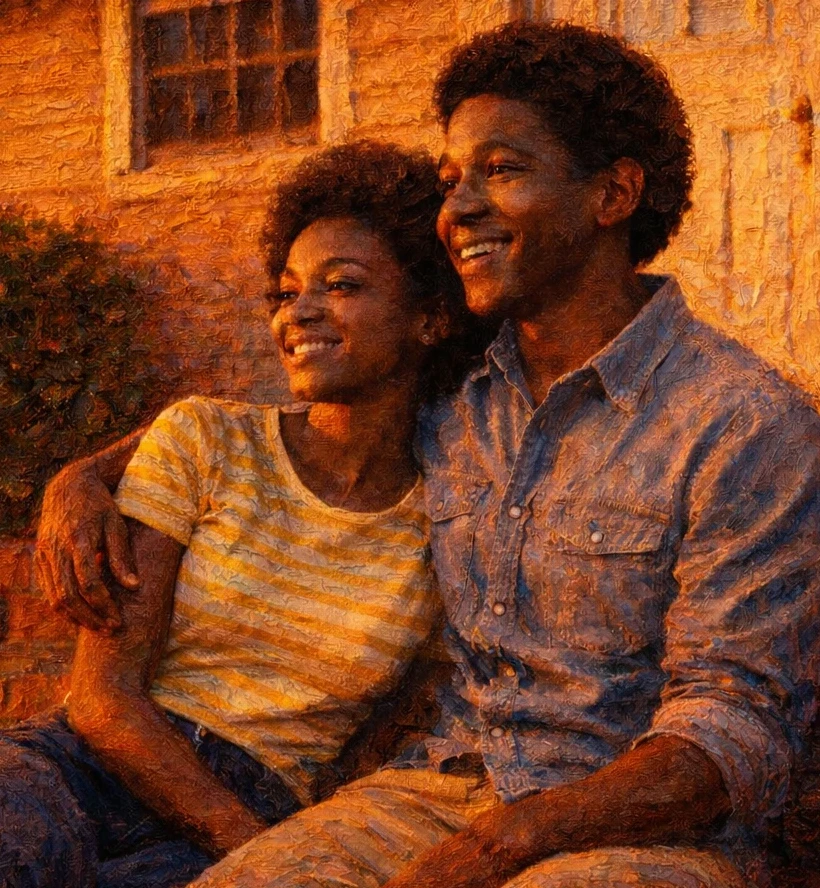
“This place raised us,” Cathy said, talking about the neighborhood.
David nodded.
“Yeah. It did.”
They didn’t cry. They looked out at the city that had shaped them, grateful for the people they’d become there.
When they finally parted—Howard calling Cathy east, and Prairie View calling David south—it wasn’t with regret. It was with respect.
They carried each other forward, into new lives, grounded by a summer that had taught them something lasting: Some loves are meant to walk with you for a season—not to fade, but to prepare you for who you’re becoming. And that was enough.