The heat came early that year. It was one of those summers where the sun felt like it was sitting low enough where you could almost reach up and touch it. On 41st and Oakland, it shimmered on the pavement, wavered above the roofs, and soaked into the front steps where Derrick and his friends usually gathered in the morning. The air had a restless feel to it, like the whole city was holding its breath.
Derrick was ten, and had just finished fourth grade at Bancroft Elementary with his boys-Tony, Marcus, and Reggie. Tony lived on the same block, but over on the Portland Avenue side. Marcus lived a couple of houses down from Derrick. Reggie lived a block over on 40th and Portland, and drifted in and out depending on what chores his moms had him doing. A few of the neighborhood girls, Kim, Nina, and Donna were always around too, usually jumping rope, or playing one of those hand clap games.
This summer was different. People didn’t say outright, but everybody felt it. It had only been a few months since Dr. King was killed down in Memphis, and not even two months after that, Bobby Kennedy. It had shaken the neighborhood in a way that even the kids could feel-something heavy, like a dark cloud hanging low over the neighborhood, something you could still taste in the air when walking down the street past 4th Avenue, or down 40th Street to the park.
Even the grown folks weren’t the same. Conversations seemed sharper, quieter, or sometimes much louder. Derrick had overheard more than one adult argue about where the world was going, and what was gonna happen next. Folks were angry. Some were scared. Everyone felt like something precious had been stolen from them. Still the kids had summer, and in the neighborhood, summer meant Phelps Park.
Phelps Park, which sat between Park and Chicago Avenues, with 39th Street on one side and 40th Street on the other, was alive by midmorning-kids running around, teenagers playing basketball, older folks sitting under the trees that lined Park Avenue, or on the park benches. A couple of kids were playing a mean game of tetherball. The wading pool sparkled like a stamp of sky on the ground. Music was playing loudly, Aretha Franklin, Archie Bell & The Drells, The Intruders, The Delfonics .
Derrick and the fellas got there a little after ten, baseball gloves in hand. They weren’t the best players at the park, but they weren’t the worst. Tony could pitch, Marcus was the fastest runner you’d ever seen, and Leon-new in the neighborhood, from St. Louis, was built like he was ten going on sixteen, so nobody ever argued when he claimed first base.
Today though, they were going to play Over-The-Fence, which is what everybody usually played when they didn’t have a lot of players. It was played on a tennis court. In the outfield there was a pitcher, three outfielders and a catcher. There were no physical baserunners, only imaginary. A ground ball that hit the bottom of the fence was a single. If you hit a grounder, or fly ball and someone fielded it, you’re out, but if they muffed it, it was a base hit. If the ball hit the middle of the fence, it was a double, the top, a triple, and over the fence, a home run.
They had been playing for a little while when Reggie showed up later, carrying his bat.
“You late again.” Marcus called out.
Reggie shrugged.
“Had to watch my sisters ’till mama got off the phone.”
He looked tired, but nobody teased him. That was just Reggie’s life.
They played a couple innings before the sun got too hot. Then everyone drifted to the shade near the park house, where Jay, one of the staff, set up board games, and coolers of water, and pop.
Around noon, Kim and Nina walked by with popsicles they bought at Dave’s Superette a block away on 38th and Chicago Avenue. Donna trailed behind them carrying a jump rope.
“Y’all playing or just sweating?” Kim asked.
“We’re too cool to seat.” Tony said.
“Uh-huh,” Nina responded. “Just keep telling yourself that.”
Donna smiled shyly at Derrick.
“You coming to the talent show on Saturday?”
Derrick shrugged.
“Maybe.”
“A lot of people gonna be there.” Donna continued. “It’s to honor Dr. King.”
That made Derrick pause.
“For Dr. King?”
“Yep” Donna said as she hurried off to catch up with Kim and Nina.
That evening Derrick found his mother watching the news. His father was still at work, and his sisters were playing jacks in the corner. The news anchor talked about protests going on around the country, some peaceful, some not. Footage of the crowds filled the screen.
His mother sighed.
“They really took that man from us,” she whispered. “Someone trying to make things better.”
Derrick sat beside her.
“Mama….why’d they kill him?”
She took a long breath before answering.
“Because some people are afraid of justice. Afraid of change. Afraid of love when it comes from the wrong skin.”
Her words felt heavy, but the way she rubbed his shoulder made them feel softer too.
“You and your friends be careful this summer,” she said. “Things are getting a little crazy.”
He nodded, even though he didn’t fully understand. He just knew everybody seemed…off. Angry. Even everyone at the park had been snapping at each other more than usual. But the talent show-maybe that would make things feel better.
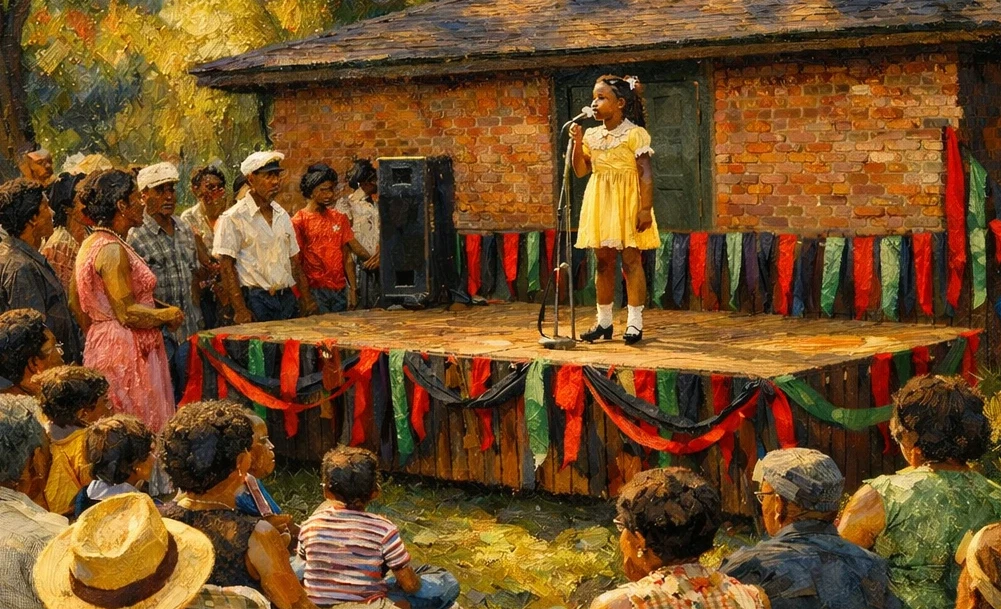
Saturday arrived and the whole neighborhood seemed to show up-families on blankets, older folks in lawn chairs, teenagers strolling through the crowd trying to see who they could see. Someone had set up a little stage near the park house, and decorated it with red, black, and green streamers. Derrick sat with the fellas. The girls were a few rows ahead, whispering and giggling.
“Who you think’s gonna win?” Tony asked.
“Donna.” Marcus said confidently. “She can sing.”
When Donna finally stepped on stage, the park got real quiet. She sang “Take My Hand, Precious Lord,” Dr. King’s favorite hymn.
Her voice wasn’t the strongest, heck, she was ten, but it was clear, sweet, and trembling. A few adults wiped their eyes. Even some older boys who usually acted too tough to care, stood still.
Derrick felt something rise in his chest-something warm and aching. The world had taken so much from the neighborhood that year. But here, in this park, a small voice was giving something back.
When she finished, the crowd erupted. Donna looked relieved and proud. Derrick caught her eye and nodded. She smiled.
Later that week, the fellas were back playing basketball. Things were going well until a group of older teens came over. Tollie, Two Tons, and Marty.
“Y’all little rookies are takin’ up the whole court.” Two Tons said.
“We was here first.” Leon replied before anyone could stop him.
It could have turned into something worse, but Jay quickly stepped in.
“Not today,” he said. “Not this summer. We’re not going to put up with any foolishness.”
The teens backed off, grumbling, but leaving it alone. Afterword, Leon kicked the dirt.
“Man, I’m tired of everybody being mad all the time.”
Derrick understood.
“It ain’t gonna be like this forever,” he said. My mom says storms don’t last. Not even big ones.
Marcus chimed in.
“We just gotta stick together.
Reggie nodded. “Yeah, Together.”
The next morning, Derrick walked over to Phelps early. The air was cooler, and the sun was just rising over the treetops. He sat on the swings, listening to the birds and the hum of Chicago Avenue waking up.
After a while his friends showed up-one by one. No plan. They just all seemed to know to come. They played ball, with all the other kids. Ran races. Played tetherball. Helped the younger kids play kickball. The girls joined them later, and they all sat on at a park table with sandwiches and laughter that felt lighter than any days since that day in April.
It wasn’t that problems were gone. The world was still hurting. Grown folks were still arguing. Teenagers still walked around with tight jaws and heavy shoulders. But the kids had each other, and in the shadow of a tough year, that meant something.
Later, as the sun dipped behind the houses on the Park Avenue side of the park, Derrick looked around at his friends-Tony clowning, Marcus bragging about being the fastest runner, Leon cracking jokes, Reggie, finally relaxed, and the girls laughing at all of them.
He felt something he hadn’t felt since before that day in Memphis.
Hope
Maybe things would get better. You just had to keep moving forward. Like the heartbeat of the neighborhood itself-bruised, but still alive. Still moving forward.