Spring came slowly to Minneapolis in 1969. The snow had melted weeks earlier, but the earth still seemed to remember winter. Patches of brown grass clung to life around the schoolyard of Horace Mann Elementary on 34th and Chicago. Boys in light jackets raced across the cracked blacktop at recess, their laughter rising into the cool air. Girls skipped rope near the brick wall. Somewhere beyond the playground, a bus groaned past on Chicago Avenue.
Inside the building, the hallways smelled faintly of chalk dust, floor wax, and cafeteria rolls. Alex Thompson, fifth grader, room 214, tried to keep his head down. He wasn’t a troublemaker. He wasn’t loud. He didn’t crack jokes in class or shove kids in the hallway. He liked books, kickball, and racing his friends down the sidewalk after school. He had a quick smile and a thoughtful way about him. Most teachers liked him. Most kids did too. But not Lester.
Lester Brown was a sixth grader. A year older. A year taller. A year rougher around the edges. He had a reputation already, though he was only twelve. Quick temper. Heavy hands. Loud voice. He walked like he owned the hallway and looked at people like he was daring them to say something. And for reasons Alex could not understand, Lester had chosen him.
It had started back in the fall—small things at first. A shove near the lockers. A sneer during recess. “Move, punk.” “Watch where you’re going.” A foot stuck out just enough to make Alex stumble. Nothing big enough to report. Nothing dramatic enough to make a scene. But constant.
Alex tried ignoring him. He took different stairwells. Ate lunch at different tables. Walked home a different route when he could. But Lester seemed to have radar. If Alex was in the milk line, Lester was behind him. If Alex was playing four square, Lester wandered over. If Alex laughed too loud, Lester would say, “What you smiling at?” Alex didn’t understand it. He had never said a word to Lester. Never teased him. Never competed with him. It was like being picked out of a crowd for no reason at all.
On that Friday in April, something shifted.
The cafeteria buzzed with noise. Trays clattered. Chairs scraped. Kids shouted across tables. The smell of sloppy joes and canned green beans floated thick in the air. Alex stood in line for milk, his tray balanced carefully in his hands. His friend George stood two places ahead, joking with another boy about the Twins’ chances that season. Alex wasn’t thinking about Lester. He should have been. A hard bump came from behind—sharp enough to jolt the tray in his hands. The milk carton tipped sideways. A few drops spilled. Alex turned slowly. Lester stood there, smirking.
“Watch it,” Alex said quietly.
Lester leaned closer. “You watch it, punk.”
The word hit different that day. Maybe it was the way he said it. Maybe it was the laughter from two boys behind Lester. Maybe it was the weeks of shoves and whispers building up inside Alex like steam in a kettle. Something in him snapped—not loud, not explosive, just firm.
“Shut up, Lester.”
The line went silent around them. Lester blinked. Alex had never talked back.
“What you say?” Lester’s voice dropped.
“I said shut up.”
For a split second, it looked like Lester might laugh it off. But pride is a fragile thing in sixth grade. Too many eyes were watching. Too many ears listening. Lester’s face hardened. His hand clenched. He swung. But before his fist could reach its target, a strong hand grabbed his wrist.
“Enough.” Mr. Hines. Tall. Stern. Hair neatly combed. Tie straight. The kind of teacher who didn’t raise his voice because he didn’t have to.
“You’re coming with me,” Mr. Hines said firmly.
He pulled Lester out of line. As he was dragged away, Lester twisted his head just enough to glare at Alex.
“I’m kicking your butt after school today,” he whispered.
The words hung in the air long after they were gone.
In an elementary school, news travels faster than the bell. By the time fourth period began, the story had grown legs.
“Lester almost knocked Alex out!”
“Alex called him out in the lunchroom!”
“They’re fighting after school!”
In the boys’ bathroom, whispers echoed off tile walls. At recess, clusters formed. Most thought Lester would win. He was older. Meaner. Used to fighting. Alex? He didn’t look like a fighter. George found him near the swings.
“You ok?” George asked.
Alex shrugged.
“I didn’t start it.”
“You gonna fight him?”
Alex looked down at the gravel.
“I don’t want to.”
“But if he comes at you?”
Alex’s jaw tightened.
“Then I’m not running.”
It wasn’t bravado. It wasn’t pride. It was just a line in the sand.
While Alex tried to focus on math problems and spelling tests, Lester sat in Mr. Hines’ classroom, stewing. He hated being embarrassed. He hated when people looked at him like he was the bad guy. He hated the way Alex had said “shut up”—calm, steady, not scared.
Lester didn’t quite understand why Alex bothered him so much. Maybe it was the way teachers liked him. Maybe it was the way other kids gravitated toward him. Maybe it was that Alex never reacted the way Lester expected.
At home, things were loud. His older brother pushed him around. His dad’s temper filled rooms. Respect was taken, not given. At school, Lester had decided he wouldn’t be the one pushed. And somehow, in his mind, Alex had become the target that proved he wasn’t weak.
The last bell rang at 3:00 p.m. Desks scraped. Books slammed shut. The hallway swelled with noise and anticipation. Alex walked with George and two other friends. His heart thumped in his chest—not with fear exactly, but with the weight of expectation. As they stepped out onto the front steps of Horace Mann, they saw him. Lester stood near the sidewalk, arms folded. Waiting. Kids lingered nearby, pretending to adjust backpacks or tie shoes. The circle was forming.
Lester pushed off the wall and started walking toward Alex. George swallowed.
“You want me to get a teacher?”
Alex shook his head. He handed his books to George.
“Hold these.”
Lester approached, shoulders squared. But as he drew closer, something caught him off guard. Alex didn’t look small. In fact, standing there on the sidewalk, Alex was slightly taller. Broader in the shoulders. And his eyes— There was no fear in them. No taunting either. Just readiness. Alex stepped forward. Lester blinked. This wasn’t how it usually went. Usually the other kid backed up. Usually the other kid pleaded. Alex didn’t. The air thickened. A shove seemed seconds away. Then—
“HEY!”
The school doors burst open. Mr. Hines and Mr. Wilson sprinted down the steps.
“There will be no fight today!” Mr. Hines barked.
The crowd scattered like startled birds. Mr. Wilson grabbed Alex’s arm. Mr. Hines grabbed Lester’s.
“Inside. Now.”
They led the boys back into the empty building. The echo of their footsteps rang in the quiet hallway. In a small office near the front, they sat the boys across from each other. Silence filled the room. Mr. Wilson leaned against the desk. Mr. Hines folded his arms.
“Do you know what would’ve happened out there?” Mr. Hines asked calmly.
Neither boy answered.
“You would’ve proven nothing,” Mr. Wilson said. “Except that you don’t know how to solve problems.”
Lester stared at the floor. Alex stared at Lester.
“Why?” Mr. Hines asked finally. “What’s this about?”
Lester shrugged.
“Use your words,” Mr. Wilson said.
Another long pause. Finally, Alex spoke.
“I don’t even know.” All eyes turned to him. “He just… doesn’t like me.”
Mr. Hines looked at Lester.
“Is that true?”
Lester shifted in his seat. “I don’t know,” he muttered.
“You don’t know?” Mr. Wilson repeated gently.
The room felt smaller. Finally, Lester’s voice cracked just slightly.
“He thinks he’s better than everybody.”
Alex blinked. “I don’t.”
“You always walking around like you don’t care,” Lester said, louder now. “Like nothing bothers you.”
Mr. Hines looked at Alex.
“Does it bother you?” Alex hesitated.
“Yeah.” The word surprised even him. “It does.”
Silence again. Mr. Wilson stepped forward.
“Listen to me, both of you. You are leaders whether you like it or not. Younger kids watch you. They copy what you do.” He gestured toward the playground outside. “If you fight, they learn that fighting solves problems.”
Mr. Hines added,
“But if you talk—really talk—you show them something better.”
He looked at Lester.
“What’s really going on?” It took a long time before Lester answered.
“My brother… he don’t let nobody mess with him.”
“And you think you have to be like that?” Lester shrugged.
Mr. Wilson nodded slowly.
“There’s strength in standing up for yourself. But there’s also strength in choosing not to swing.”
He turned to Alex.
“And you—standing there ready to fight doesn’t make you wrong. But what would winning prove?”
Alex thought about it. Nothing.
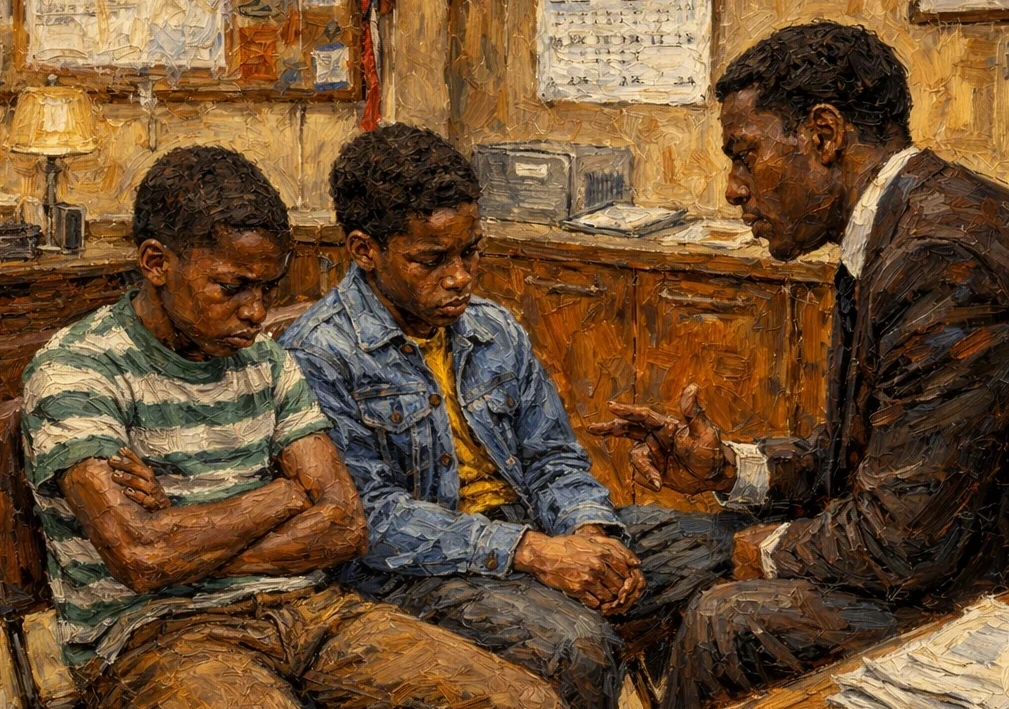
The teachers made them sit there until the anger drained out of the room. They made them talk—not yell, not accuse, just explain. Alex admitted he was tired of being shoved. Lester admitted he didn’t like feeling invisible. They discovered something neither expected. They both loved baseball. They both hated math. They both walked home past the same corner store. It didn’t make them friends. But it cracked the wall.
Finally, Mr. Hines stood.
“I want you two to shake hands.”
They hesitated. Then, slowly, they did. Not warmly. Not enthusiastically. But firmly.
“You don’t have to like each other,” Mr. Wilson said. “But you will respect each other.”
“And you will be examples,” Mr. Hines added.
Outside, the late afternoon sun dipped lower over Chicago Avenue. When they stepped outside again, most kids were gone. George waited across the street.
“You alive?” he joked nervously. Alex nodded.
“No fight.”
Lester stood awkwardly a few feet away. For a moment, it looked like he might say something. Instead, he nodded once. Not friendly. Not hostile. Just… different. Then he turned and walked the opposite direction. Alex picked up his books. As he walked home, the tension that had gripped his chest all day slowly eased. He realized something important. Sometimes the bravest thing isn’t throwing a punch. Sometimes it’s standing your ground long enough for someone to see you differently.
Epilogue The next Monday at school, things felt different. Lester didn’t bump him in the hallway. Didn’t sneer in the milk line. He didn’t smile either. But he left Alex alone. And that was enough. Over time, the edge softened. They never became best friends, but they became something better than enemies.
Years later, when Alex would think back on Horace Mann in the spring of 1969, he would remember the almost-fight. He would remember the moment he realized that strength isn’t about who swings first. It’s about who chooses not to. And somewhere in that brick school on 34th and Chicago, two boys learned that being an example sometimes starts with swallowing your pride.
The fight that day never happened. But something stronger did. And it lasted much longer than bruises ever could.