November rolled in like a gray whisper—cold mornings, early darkness, and bare trees lining the city like skinny, shivering sentries. For Derrick, the days felt quieter. Not sad quiet—thoughtful quiet. Like the world was waiting for something. Football was done. The excitement of the new fifth grade year was settling. Winter coats came out of closets. Windows fogged up in classrooms. And the everything shifted into a slower rhythm.
Mrs. Andrews announced something that made half the class groan and the other half cheer:
“We’re going to the school library every Monday and Thursday for independent reading.”
Derrick didn’t mind. He actually liked the smooth feel of books in his hands and the smell of the library—dusty, warm, and full of possibilities. He often sat at a round table with: TJ, who devoured books about rockets and science, Lisa, who sketched illustrations in the margins of her notebook, Gordy, who was discovering he liked history, Yolanda, who checked out books twice her reading level, and Cal, who usually pretended he didn’t like reading but always finished his book first.
One November afternoon, they all sat together in a circle of concentration.
“You ever think,” TJ said suddenly, “that books are the only place where everything makes sense?”
Lisa didn’t look up. “Books don’t make everything make sense.”
“Yeah,” Cal said. “But they make you think like it does.”
Derrick smiled, quietly agreeing. Books made the world feel a little less crowded.
The first really big snowstorm of the season hit the the day before Thanksgiving. Thick, heavy flakes. Wind whipping down the Street. Snow piling against steps and porches. Kids cheering because school let out early. Derrick rushed home with his sisters. For dinner their mother made cornbread and stew. Word could not describe how good it was.
Later, as the storm settled and the world grew quiet, Derrick sat at the living room window, looking out at the soft white glow of streetlights reflecting off the snow. He thought about Warrington, Bancroft, his football team at Phelps, his new classmates. His friends, being ten, and what it meant to grow up in a neighborhood that was changing and hurting but still strong. He didn’t fully understand it, but he felt it.
Thanksgiving at Derrick’s house was loud, warm, and filled with food: Turkey, cornbread dressing, with sage, sweet potatoes with marshmallows, collard greens, and peach cobbler. Family filled the house—cousins, uncles, neighbors who were practically relatives anyway. His father led a small prayer:
“Lord, we thank You for another year. For life, for breath, for this home, for this neighborhood, and for the strength to keep going in a world that doesn’t always understand us.”
Everyone murmured “amen.” Derrick breathed in the warmth and love around the table. Then the Saturday after Thanksgiving, the tradition was that everyone headed over to Aunt Emma and Uncle Earl’s home over north. They were really Derrick’s great aunt and uncle. There was so much food, and everyone was there.
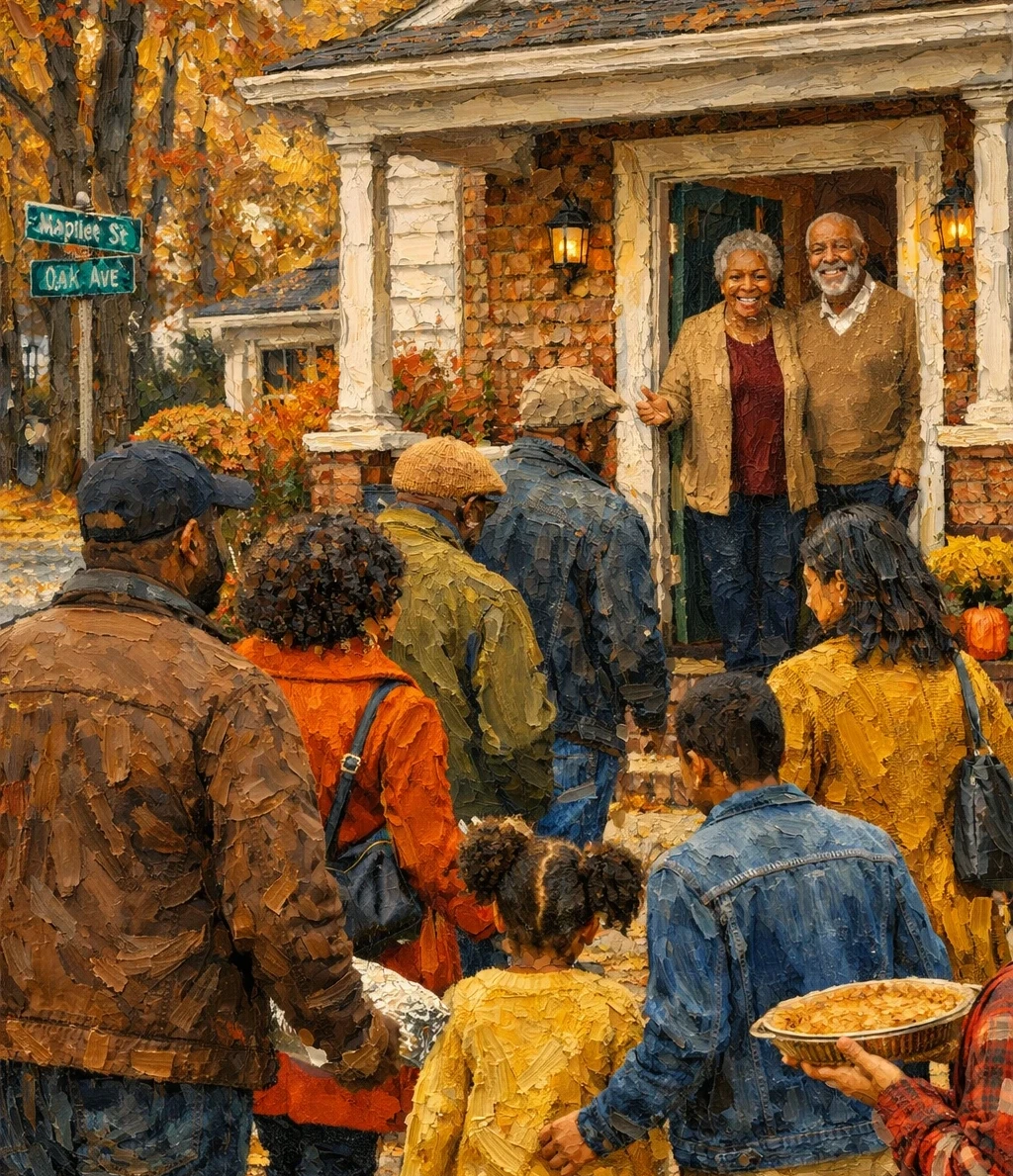
After dinner, instead of going and playing with all of his many cousins, Derrick like to sit in the den where all of the adults would gather, and listen to them talk about the old days. He didn’t realize it then, but these were the moments that would stay with him forever.
December brought shorter days, bright holiday decorations on porches, and the smell of pine and cinnamon, and a kind of peaceful energy that filled the neighborhood. A small winter festival was set up. It was nothing fancy. It was just a tree lighting with hot chocolate, a choir from Sabathani, and a table where kids could make paper snowflakes. Everyone wandered around together, bundled in thick coats and scarves. Marcus tried to lead them in a snowman-building contest, but Tony knocked the snowman over.
“You jealous ’cause his head was rounder than yours,” Marcus said.
“You jealous ’cause his nose was bigger than yours,” Tony shot back. Everyone laughed. Even Leon cracked a smile. Reggie drank so much hot chocolate he looked ready to burst.
Bancroft held its annual holiday program in mid-December. Parents packed the gym whe, and kids fidgeted backstage, nervous and excited. Derrick’s class sang “This Little Light of Mine.” Lisa drew the program cover. TJ played a shaky solo on the recorder. Yolanda gave a short speech about kindness across communities. Cal read a poem he pretended he didn’t write but absolutely did. When the curtain closed, parents clapped loudly, and Derrick noticed something important: Black parents. White parents. Parents from all over the neighborhood. Sitting together. Smiling. Clapping for the same kids. If there had been any tension about integration when Warrington closed, it wasn’t visible now. The room felt like a single community. Warm. Unified. Hopeful.
After one of the last days before winter break, Derrick walked home alone for once—no crew, no chatter, just the hush of the neighborhood in winter. Snowflakes drifted through streetlights. Cars moved slowly along the street. Kids played in the last sliver of daylight. He felt older somehow. More aware things going on the world. More connected to it. He thought about football victories, snowball wars, new friends, old friends and how life felt bigger. He thought about how fifth grade wasn’t as scary as he thought it was going to be.
As he turned onto his block, he saw his house lit from inside, warm and familiar. His mother’s silhouette moved across the kitchen window. His father stepped onto the porch to shake off fresh snow. His sisters ran outside to greet him, laughing. And Derrick felt something strong and steady settle inside him: He belonged. Here. In this neighborhood. In this moment. In this life. 1968 had shaken the world. But here, in the winter, there was still light. Still warmth. Still hope. And he carried that with him as December deepened and the year came to an end.