It was a hot summer day in July 1968. The sun had been sitting on South Minneapolis all day like a heavy hand. By late afternoon the air above the sidewalks shimmered, and the tar seams along the street looked soft enough to press a thumb into. Derrick had been sweating through his T-shirt since noon, but he didn’t care. Ten years old felt like the perfect age for a bike—old enough to ride wherever you wanted, young enough that nobody expected you to make sense.
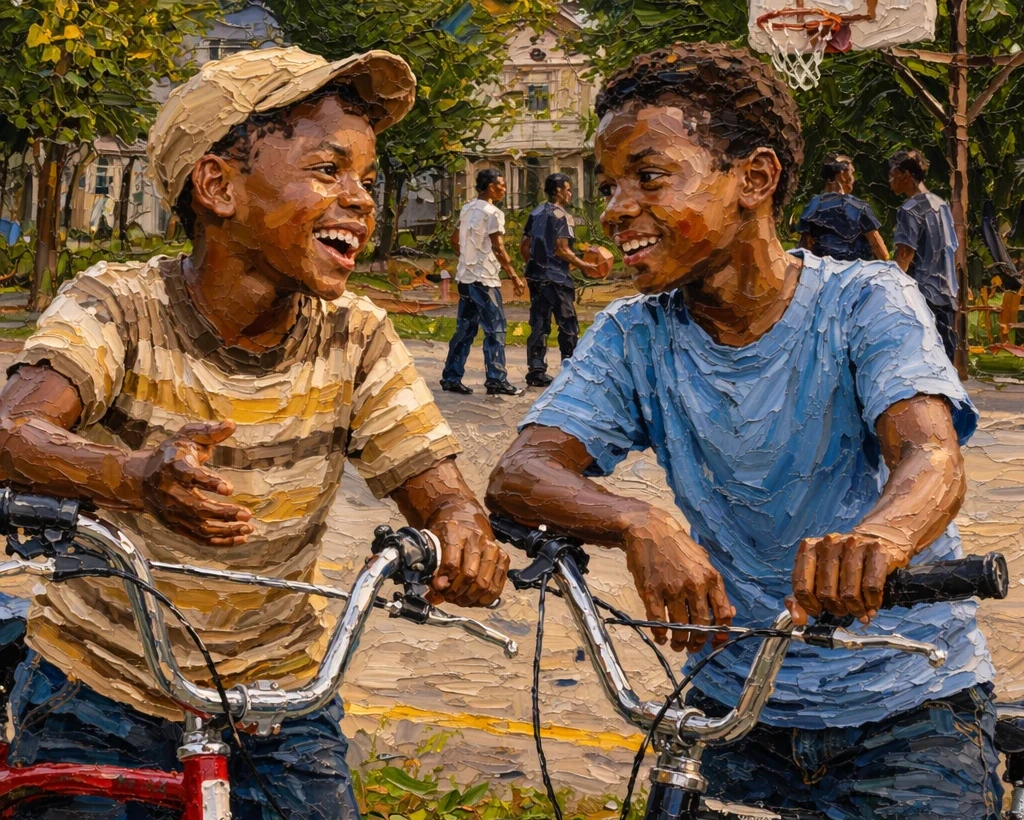
Michael lived over on 41st and Portland, in a narrow house with a little porch that always smelled faintly like laundry soap and fried onions. Derrick had pedaled down there after lunch, cutting through alleys where the garbage cans baked in the sun and the lilac bushes were tired and droopy. Michael met him outside holding a tin cup of Kool-Aid like it was a trophy.
“Cherry,” Michael announced.
“Lucky,” Derrick said, and wiped his forehead with his sleeve.
“You ready?” Michael nodded, and together they rolled their bikes off the curb like they were releasing horses.
Their bikes weren’t fancy, but they got them where they wanted to go. They rode down Portland, across blocks where lawns turned yellow at the edges, past porches where grown-ups sat in folding chairs fanning themselves.
They rode for a couple hours, stopping at May’s Superette on 36th and 4th Avenue for penny candy and lingering in the shade of a big tree, daring each other to ride no hands, then laughing when one of them wobbled and almost ate it.
The city in late July felt like one long exhale. Even the sounds were lazy—the distant hum of a lawn mower, the slap of a screen door, the faint crackle of a radio from an open window.
Every so often a bus would groan past and leave a hot gassy smell behind.
“Let’s go to Phelps.” Derrick said, because Phelps Park was always a destination, even if you didn’t have a reason.
The park was like a whole world: ballfields, playground, basketball courts, trees that made shade you could actually feel. It was where older kids went when they wanted to show off, where grown-ups came when they wanted to sit and talk, where you could go and see your friends. Michael shrugged like he didn’t care, but his eyes lit up.
“Okay.”
They cut over, weaving through side streets, riding past a little cluster of houses that always had kids on the steps. Derrick liked the feeling of heading somewhere with Michael. It made the afternoon feel like an adventure.
By the time they reached Phelps, their legs were starting to burn a little after a whole afternoon of riding. But the park looked different than it usually did. The park building sat there like it was holding its breath.
“What’s up?” Michael asked. Derrick slowed, coasting.
“Park closed over dinnertime,” he said. . It was when the people who ran the park youth programs were gone for dinner break.
Over near the basketball court, a few older teens were playing, the ball slapping the asphalt with a steady rhythm. Their voices carried across the open space—sharp, confident, and talking trash. Derrick and Michael rode slowly along the path, keeping to the edge, trying to look like they belonged without actually getting close enough to get yelled at.
Then Derrick saw it: a white guy over by the jungle gym, doing pull-ups like he was practicing for the Army or something. He wasn’t a kid. He was older—late teens, maybe. His arms were pale and lean, his hair cut short. Every time he pulled himself up, his shoulders bunched and his elbows flared. He wasn’t smiling. He looked focused, like he was doing something private. And around him, closing in, was a group of older Black teens. Not the basketball guys. Different ones. They moved like they had a plan. Derrick’s stomach tightened. He didn’t know why right away, but he did. The air felt thicker.
One of the teens—tall, with a hard face and wearing a white T-shirt, stopped close enough to the jungle gym that his shadow touched the white guy’s legs.
“You can’t be here,” he said.
The white guy kept going for one more pull-up, like he hadn’t heard. Then he dropped down and turned, breathing hard.
“What?” he said, irritated.
Another teen stepped forward and grabbed the bar with one hand, as if claiming it.
“This is our park,” he said. The white guy’s face changed. His mouth opened like he’d been slapped.
“You ain’t got no right to—”
He didn’t finish. Somebody shoved him. He stumbled back and hit the ground, landing on his side. Derrick flinched like the shove had hit him instead.
“Don’t nobody want us coming to your parks,” one of them said. “So you can’t come to ours.”
The white guy pushed himself up, dust on his elbow, anger and disbelief tangled together. He looked around like he expected someone—anyone—to say something, to step in. But nobody did. Not the basketball guys. Not the older people. Not the park building. Derrick and Michael sat frozen on their bikes, feet on the ground, hands tight on handlebars. The white guy started to stand taller, started to form words again, but his eyes moved over the faces around him, and something in him recalculated. He swallowed. He took a step back. Then another teen shifted forward, and the white guy’s bravery collapsed like a folding chair. He turned and walked away, fast, shoulders tense, like he was trying not to run.
The group watched him go, satisfied, as if they’d just corrected something that needed correcting. Michael let out a breath Derrick hadn’t realized he’d been holding.
“That was messed up,” Michael whispered.
Derrick didn’t answer. His throat felt tight. He had seen fights before, seen people get jumped behind garages or at the corner lot, but something about this felt different. It felt like the park itself had rules Derrick didn’t fully understand. They stayed near the edge, riding slow circles, trying to act normal while their minds kept going back to the scene at the jungle gym.
A while later, another white guy came riding into the park on a bike. He was tall and bony, with thick glasses that made his eyes look bigger. He rolled in like he didn’t know anything was wrong with the world, like it was just another hot summer day and he was just passing through. He stopped at the water fountain, leaned down, and drank. The same group of older teens drifted toward him like smoke. Derrick’s heart sank before anything even happened. He almost wanted to warn the guy, but his voice wouldn’t work.
The white guy looked up, saw them, and something in his face tightened. He pushed off the fountain and swung his leg over the bike like he meant to leave. But one of the guys reached out and caught the back of the seat. The bike jerked. The white guy lost balance. “Ooooo!” one of them crowed. “A backhand.” The tall white guy fell sideways from the blow, hands slapping the ground, glasses tilted. He scrambled up, and Derrick saw blood immediately—bright and shocking against his pale skin. His nose was bleeding, and not a little. It ran down to his lip, dripped onto his shirt. He looked around wildly, more scared than angry, as if he couldn’t believe a simple drink of water could turn into this.
The teens didn’t chase him. They didn’t need to. They had made their point. He climbed back on his bike with trembling hands and rode out fast, wobbling at first, then steadying, blood trailing down his face and dripping onto the handlebars. Derrick watched him go until he disappeared past the trees.
Michael’s voice was small.
“He didn’t even do nothing.”
Derrick’s jaw clenched. He didn’t know what to say that wouldn’t get them in trouble with the wrong people—even though it was just the two of them. They rode out of the park not long after, heading back toward 41st and Portland. The sun was starting to lower, but it was still hot enough to make the back of Derrick’s neck slick with sweat.
They pedaled in silence for a while, the kind of silence that wasn’t comfortable but was safer than talking. Halfway back, Michael finally spoke, his eyes fixed on the road.
“I was pulling for them white guys,” he said.
Derrick turned his head, surprised.
“What?”
Michael swallowed. “I mean… they wasn’t doing nothing. They was just minding their own business.”
Derrick felt irritation flare up so quick it startled him. It wasn’t just what Michael said—it was how simple he said it, like it was obvious. Like Derrick was supposed to agree.
“You ain’t supposed to say stuff like that,” Derrick snapped.
Michael looked at him, confused.
“Why not?”
Derrick didn’t have a clean answer. He had a hundred tangled ones in his head that went like: Because you don’t know who’s listening. Because folks will think you’re taking sides. Because grown-ups say things about how you’re supposed to stick together. Because everything is complicated and you’re only nine and I’m only ten and we don’t know what we’re talking about. But instead Derrick said,
“Just… don’t.”
Michael’s mouth tightened. He nodded like he understood, but his eyes said he didn’t. When they reached Michael’s house, they leaned their bikes against the porch and stood there for a second, breathing hard, sticky with sweat and dust. Inside, Michael’s mom called his name, telling him to wash up for dinner.
Derrick headed home, riding slowly, thinking about the two white guys, thinking about the older teens’ faces, thinking about what it meant when somebody said, “This is our park.”
That evening, after dinner, the heat eased just a little, and people started drifting back toward the park again like the day’s tension had been a curtain that could be pulled aside. Phelps opened back up, after dinnertime.
Derrick couldn’t help himself. He went back, not because he wanted trouble, but because his mind needed to see if the world had snapped back into place. There were more people now. Little kids on the swings, older teens lingering at the court, grown-ups talking by the park building. It looked normal.
Almost.
Then Derrick saw the tall white guy with thick glasses again. Except this time, he wasn’t alone. A police car sat near the park building, and the tall guy stood beside it, his nose swollen, dried blood still visible in the corners. A policeman in a short-sleeved uniform was asking questions, his notebook out. Derrick’s stomach dropped.
The presence of the police changed the air instantly, like someone had turned down the music. Kids watched from a distance, pretending not to watch. Conversations got quieter. People shifted positions like they wanted to be invisible.
The policeman started stopping kids, asking if they’d seen anything. Some shook their heads fast. Some stared at the ground. Some just walked away. Derrick kept to the edge, trying not to look suspicious just by standing still. Then he heard a voice—sharp, familiar.
“It was them dudes over by the jungle gym,” the voice said.
Derrick turned. Eric Willard stood there, hands on his hips, chin lifted, talking to the police like he didn’t care who heard him. Eric Willard. Eric was a kid everybody knew for all the wrong reasons. Always in trouble. Always talking back. Always starting something. Derrick had beef with Eric more times than he could count—arguments, pushing matches, ugly words that made your ears burn. Eric and Derrick did not get along. Not one bit. So seeing Eric talk to the police felt like seeing a dog stand up and start speaking English.
The officer leaned closer, listening, writing. Eric pointed toward the jungle gym area, describing what happened, his voice steady. He didn’t glance around to see who was watching. He didn’t lower his tone. He just told it.
Derrick felt a strange mix of emotions—shock, admiration, unease, because talking to the police in front of everybody? You don’t do that. That took courage, or recklessness, or both.
Derrick glanced around and saw faces harden, saw some older teens staring at Eric with cold eyes. People didn’t like that. People had rules about that too. Eric kept talking anyway. Derrick realized something then that he hadn’t been able to put into words all day: the park wasn’t just swings and courts. It was a battlefield of invisible lines. And today, those lines had been stepped over by everybody—by the white guys, by the older teens, by the police, and now by Eric Willard.
Eric finished and stepped back, wiping sweat from his forehead like he’d just completed a chore. The policeman nodded and moved on. Eric stood there for a second, eyes sweeping the crowd, daring anybody to say something. Then he walked off like it was nothing. Derrick watched him go, surprised all over again.
He still didn’t like Eric. That didn’t magically change. But Derrick felt something shift inside him—something small, but real. Maybe Eric wasn’t just trouble. Maybe he wasn’t just the enemy. Maybe, in a world full of messy rules and loud loyalties, there was still room for somebody to do the right thing—even if they weren’t the kind of person you expected it from.
Derrick sat down on the edge of the curb near the path, his bike beside him, and stared out at the park. The sun was lower now, throwing long shadows. Kids laughed near the swings. A basketball thumped steadily somewhere behind him. The evening tried its best to feel normal again. But Derrick knew he would remember this day. The heat. The riding. The way two men had been told they didn’t belong. The way Michael’s words had made Derrick mad because they sounded like truth. The way blood looked too bright against skin. And the way Eric Willard—of all people—had stood up and spoken when everybody else stayed quiet.
Derrick tightened his grip on his handlebars and exhaled. Maybe hope came in strange packages. Maybe courage wasn’t always clean. And maybe—just maybe—Eric Willard had more to him than Derrick had ever wanted to admit.