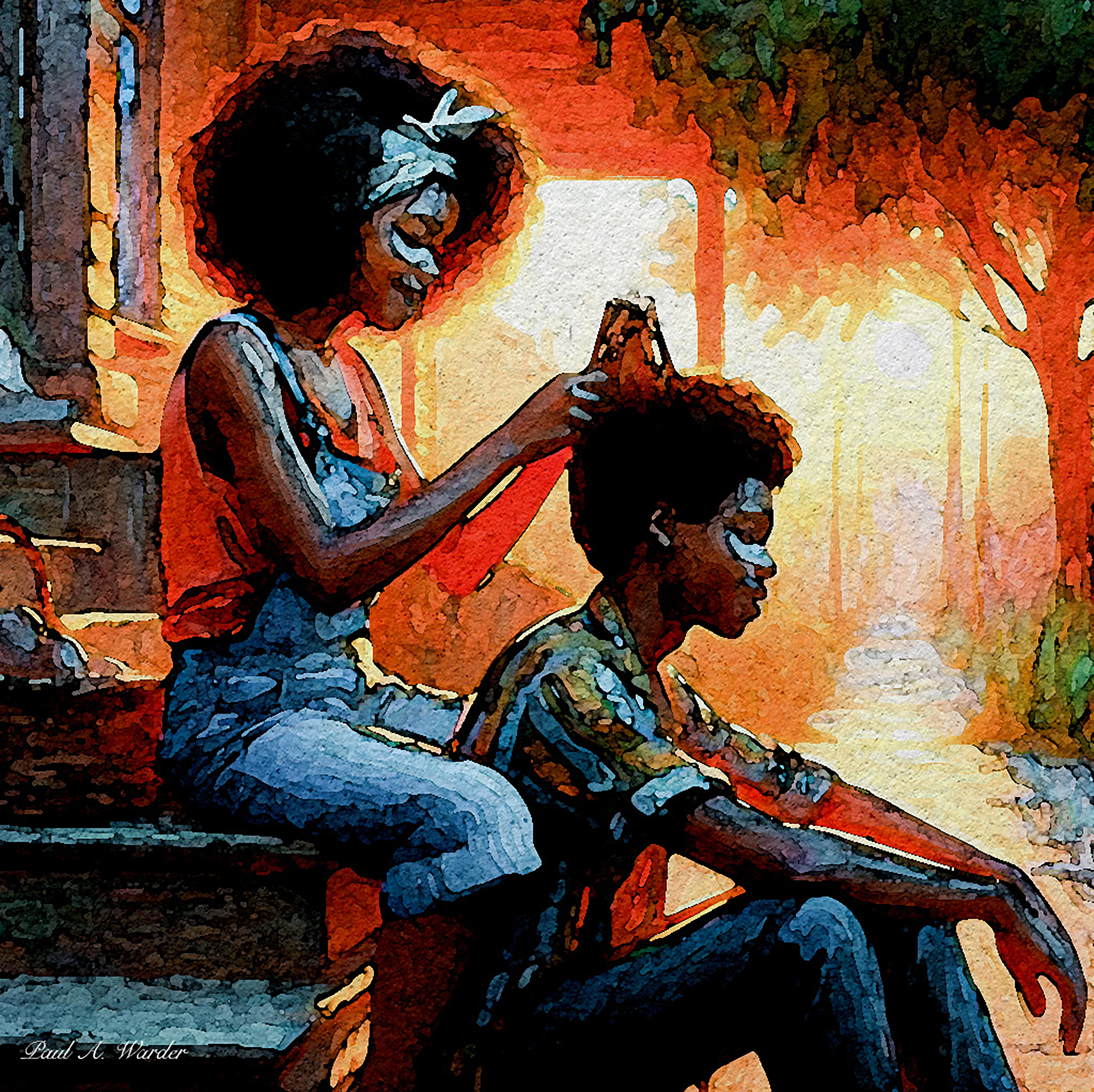
The heat had finally let go of the day. Not all at once—summer never did anything politely—but in slow concessions. The sun slid behind the houses like it was tired of looking at the same block, and the air turned honey-thick instead of stove-hot. Shadows stretched across the cracked sidewalk, and the sky beyond the trees had that late-evening reddish orange, the kind that made the windows glow and the street feel like it was holding its breath for night.
On the front steps of the duplex, Keisha sat one step higher than Sylvester, or Syl as everyone called him, and pulled a comb through his hair.
“Stop moving,” she said, not mean, just firm.
“I’m not moving,” Syl said.
“Your head is.” Keisha rep sighed, exaggerated.
“My head is attached to my body.”
“And your body is attached to a mouth that don’t know when to hush.”
She took a section of hair between her fingers and smoothed it. The comb was warm from the day. Her hands were steady. Keisha always did things steady, like the world would tilt if she didn’t.
Syl leaned forward, elbows on knees. His arms were long for fifteen. Everything about him was long—legs that didn’t know what to do with themselves, fingers that could palm a basketball and also play the opening piano chords of every song he’d ever heard on the radio. He wore a short-sleeved shirt with the collar turned up and a pair of jeans that had been patched twice at the knee. The patches didn’t match, and he pretended not to notice.
Keisha sat behind him in a red top, her hair wrapped up with a pale bow that caught the last light. She had a towel over her lap like she was cutting hair in a shop, like she was somebody’s auntie with her own chair and her own rules. She was wearing overalls jeans that stopped just below her knees. She didn’t care what anyone thought. She wore what she wore.
From the sidewalk came the sound of bicycle tires rolling over grit and the distant call of somebody’s mom, the word “boy” drawn out like a warning. Farther down, a porch radio crackled something slow, something with horns, something that made you think of ice sweating in a glass. Keisha clicked her tongue.
“Your mama gonna say something if I make you look too nice.”
Syl laughed, soft.
“She only say something if I come in and my stuff isn’t lined up right.”
Keisha tugged gently at the hair near his crown.
“Hold still.”
Syl’s gaze stayed on the street, but his mind wasn’t there. Keisha could tell. She could always tell. He had that look again. The one he’d been wearing for weeks now, like there was a thought in his head too big to get out in a sentence. Like he was carrying a secret the way folks carried groceries—careful, arms strained, praying nothing slipped.
Keisha combed, parted, smoothed. She worked the way her grandmother had taught her on Saturday mornings, when Keisha was little and her mother was already at work. “Baby hair first,” Grandma would say, and then, “Don’t rush. Hair remember rushing.”
“Where you been today?” Keisha asked, casual, like she wasn’t already reading him.
Syl shrugged.
“Around.”
Keisha let the comb pause, mid-air, and leaned forward until her chin almost touched the top of his head.
“That mean you been somewhere you ain’t supposed to.” Syl rolled his eyes.
“I been down by the park.”
“Mm-hmm.”
“With Kenard and Bruce.”
“Mm-hmm. And what were you doing?”
Syl’s shoulders rose and fell. He didn’t answer. Keisha resumed, her fingers gentle at his scalp. For a second, the only sounds were the comb’s soft scrape and the neighborhood exhaling—screen doors, laughter, a car passing slow like it had nowhere important to be.
“Syl,” Keisha said. “You know you can tell me, right?”
He didn’t turn, but his voice changed when he spoke. It got smaller.
“What if it’s stupid?”
Keisha snorted. “Everything you do is either stupid or brave. Sometimes both.”
That pulled a real laugh out of him. He shook his head, then remembered her warning and froze. Keisha smiled despite herself.
“There. That’s better. Now—talk.” Syl watched the end of the block where the streetlight pole stood, not lit yet, just waiting.
“Coach Walker came by the park.
” Keisha’s eyebrows lifted. Coach Walker was a local legend and a local headache. He had a whistle around his neck even when he wasn’t coaching, like he might blow it at any moment just because somebody had the wrong kind of attitude. The older boys said he could see a jump shot from a mile away, and the moms said he could see trouble before it happened.
“He did?” Keisha asked, trying not to sound interested.
Syl nodded.
“He watched us play. Like… for a long time.”
Keisha worked the comb through another section, slower now.
“Okay.”
Syl swallowed.
“After, he pulled me aside.”
Keisha’s fingers tightened on the hair just enough for Syl to feel it.
“And?”
“He said… he said there’s a summer program. For basketball. Like, real training. They take you to a college gym. You play other schools. They got coaches and… and somebody talk about scholarships.”
Keisha let that sit in the air. The word scholarship sounded like a door opening to somewhere you’d only seen in pictures. It sounded like money without begging for it.
“That’s good,” she said quietly. Syl’s laugh was short.
“That’s what you’d think.”
Keisha resumed combing, but her eyes narrowed.
“Why you saying it like that?”
Syl rubbed his palms on his jeans.
“Because it cost.”
Keisha didn’t ask how much. She could guess. Everything that mattered cost. “How much?”
Syl sighed.
“Coach didn’t say exact. He said you gotta pay for the uniform and the bus and the… the registration. He said they might have help for some kids but you gotta talk to somebody and fill out forms and—”
“And your mama don’t got time for that,” Keisha finished.
Syl’s shoulders sank.
“She got time to work. That’s what she got time for.”
Keisha leaned back, letting the comb rest against her palm. She looked at the side of his face—his cheekbone, the line of his jaw, the way his eyelashes caught the last light. Syl wasn’t little anymore. That was the trouble. Kids were small enough for the world to ignore. Teenagers were big enough for the world to start demanding things.
“You told her?” Keisha asked.
Syl shook his head. “Not yet.”
“Why not?”
He hesitated.
“Because she already got so much going on.”
Keisha knew. Everybody knew. Syl’s mom, Ms. Johnson, worked early shifts at the hospital cafeteria and late shifts cleaning offices downtown. Syl had a little sister, Yolanda, who liked to pretend she was grown but still fell asleep with her thumb in her mouth. Their fridge always had something in it, but never extra. The kind of house where the lights stayed on because somebody kept feeding quarters into the meter like a prayer.
Keisha looked at Syl’s hair, half done now, neat part forming, the shape coming together.
“You can’t decide what she can handle,” she said.
Syl’s voice got defensive.
“I’m not deciding. I’m… protecting.”
Keisha made a sound.
“Boys always think hiding things is protecting. Half the time it’s just fear with a cape on.”
Syl glanced up toward her, then away.
“You always got something smart to say.”
“I do,” she agreed. “Now tell me the real part.”
Syl’s hands clenched.
“Coach said he could put my name in. But it gotta be this week. He said—he said if I want it, I gotta move.”
Keisha breathed out slowly. The sky had turned deeper orange, like a bruise beginning to show.
“So you want it?”
Syl’s answer came out fast.
“Yeah.”
Just one word, but it held everything—every hour in the park, every shot taken until the sun went down, every time he’d run home with sweat on his neck and hope in his chest. Keisha felt it like a weight and like a wing at the same time.
“Then we move,” she said.
Syl turned his head enough to look at her, startled.
“We?”
Keisha tapped the comb against his shoulder.
“Don’t get sentimental. I’m not joining no basketball program.”
“I mean—” Syl started, then stopped. He didn’t know what to do with kindness sometimes. He didn’t know where to put it.
Keisha went back to work, her tone brisk.
“We start with forms. We start with asking. We start with not acting like the world only got one answer.”
Syl’s voice was careful.
“Keisha… you don’t understand.”
Keisha huffed. “I understand plenty.”
He swallowed.
“Coach Walker said something else.”
The comb paused again.
“What?”
Syl stared at the sidewalk, like the cracks might help him.
“He said… he said I gotta keep my grades up. He said they don’t take kids who can’t handle school. He said if I mess up, I don’t just mess up me. I mess up the chance.”
Keisha’s eyes softened.
“That part is true.”
Syl’s mouth tightened.
“But school—”
Keisha finished for him, because she knew: School was hard when you were tired. School was hard when you had to watch your sister. School was hard when teachers looked at you like they expected less. School was hard when your mind was full of noise.
Keisha said,
“You ain’t dumb, Syl.”
He didn’t answer.
“You ain’t,” she repeated, sharper now. “Don’t let them put that on you.”
Syl’s voice cracked just a little.
“Sometimes I feel dumb.”
Keisha’s heart pinched, but her hands stayed steady.
“Sometimes I feel like screaming at grown folks. Feelings ain’t facts.”
Syl laughed weakly. “You always talk like you sixty.”
“Better than talking like you two.”
She pulled the comb through the last section, then sat back and studied the shape. It wasn’t a fancy cut. She didn’t have clippers or a shop mirror. But it was clean. It was careful. It looked like somebody cared enough to take time.
Keisha brushed loose strands from her fingers and reached for the jar of grease she’d brought out with her. She scooped a little and warmed it between her palms.
“What you doing?” Syl asked.
“Finishing,” she said.
She smoothed the grease along his hairline, pressed the edges down, then used the comb to lay everything where it needed to be. Her hands moved with a kind of love that didn’t require permission. When she was done, she tapped his shoulder.
“Go look in the window.”
Syl stood and walked to the front door. The porch light wasn’t on yet, but the glass reflected enough. He leaned in, turning his head side to side. Then he smiled, surprised.
“Dang,” he said softly. “I look… like I’m somebody.”
Keisha leaned back against the rail, pleased.
“You always been somebody. You just ain’t been seeing it.”
Syl came back and sat on the step below her again. He didn’t want to mess it up by leaning against anything. That made Keisha grin. Down the block, the streetlight blinked on, one orange bulb at a time, like the neighborhood was waking up into a different kind of day.
Syl said, “You ever think about leaving?”
Keisha’s smile faded. That question had teeth. “Leaving where?”
“Just… leaving,” he said. “Like… you know. Not being here forever.” Syl continued.
Keisha stared at the street. The trees moved slightly in the breeze. Somewhere a dog barked twice, then stopped.
“Everybody think about leaving,” she said. “Even folks who act like they don’t.”
Syl’s voice got quiet.
“Would you go?”
Keisha’s throat tightened. She imagined it: a bus station, a suitcase, a place where nobody knew her mama’s business or her daddy’s absence. A place where the air didn’t smell like asphalt and fried onions. A place where she could start over and not carry everybody else’s expectations like a backpack. But then she pictured her little brother, Darnell, sitting at the kitchen table with his tongue out, trying to write his spelling words. She pictured her mother’s tired eyes. She pictured the way the neighborhood women called her “Baby Girl” like she belonged to all of them.
“I don’t know,” she admitted, surprising herself.
Syl nodded like he understood that kind of answer.
“Sometimes I feel like if I don’t get out, I’m gonna get… stuck.”
Keisha looked at him.
“You ain’t stuck yet.”
“How you know?”
“Because you still dreaming,” she said. “Stuck people don’t dream. They just complain.”
Syl rubbed his hands together.
“Coach said the program could help. He said it could open doors.”
Keisha said, “Then we open them.”
Syl smiled a little, but worry returned quick.
“How?”
Keisha tilted her head, thinking.
“First,” she said, “you tell your mama tonight.”
Syl groaned.
“Keisha—”
“Tonight,” she repeated, voice like a gavel. “Before the fear talk you out of it.”
Syl looked away, toward the streetlight.
“She gonna say no.”
“You don’t know that.”
“I do.”
Keisha leaned forward.
“Syl. Listen to me. Sometimes grown folks say no because they tired. Sometimes they say no because they scared. Sometimes they say no because they don’t want you to want something they can’t give.”
Syl’s eyes flickered. Keisha continued, softer now.
“But your mama love you. And love don’t always look like yes. Love sometimes look like… trying.”
Syl swallowed.
“You make it sound easy.”
“It ain’t easy,” Keisha said. “It’s just necessary.”
They sat in the orange light for a moment, both quiet, listening to the block. A car rolled by slow. A group of teenagers laughed too loud at something that wasn’t that funny. Somebody’s screen door slammed. The night settled in around them like a blanket with holes.
Syl said,
“What if I don’t make it?”
Keisha’s eyes snapped to him.
“Make it where?”
“To the program. To college. To… whatever,” he said, frustrated. “What if I try and it still don’t happen?”
Keisha took a breath. She had been saving this truth for someone, she realized, like a coin kept in a pocket until it was worth spending.
“Then you still tried,” she said. “And that matters. Trying changes you.”
Syl frowned.
“How?”
Keisha pointed with the comb toward the street, toward the line of houses, toward everything familiar.
“Because this block will tell you what you are,” she said. “It’ll tell you you just somebody’s son, somebody’s problem, somebody who ain’t supposed to get too far. Trying is how you argue back.”
Syl stared at her. The last light caught his face, and for a second he looked younger than fifteen—like a kid who still believed adults had secret answers. Keisha glanced away, suddenly shy. She wasn’t used to being looked at like that.
Syl said quietly,
“Why you care so much?”
Keisha’s fingers tightened on the comb again. She could’ve joked. Could’ve said, Because your head was looking like a busted mop and I couldn’t let you walk around like that. Could’ve said, Because you owe me two dollars from last week. But something in the evening made honesty easier.
“Because you my friend,” she said simply. “And because I’m tired of seeing people on this block give up before they even start.”
Syl’s voice got small.
“Sometimes I think you the strongest person I know.”
Keisha scoffed.
“Please.”
“I’m serious.”
Keisha shook her head.
“Strength ain’t always loud, Syl. Sometimes it’s just… not quitting.”
He nodded slowly, like he was filing that away. The porch light clicked on behind them. Keisha’s mother had flipped it from inside, her way of saying, It’s getting late without having to call out.
Keisha stood and dusted off her skirt.
“Alright. Go on,” she said. “Tell her.”
Syl stood too, but he didn’t move. The idea of walking home with that conversation sitting in his chest felt like walking into cold water. Keisha stepped closer and fixed his collar like he was going to church.
“You can do hard things,” she said, quietly enough that it felt like it belonged only to them.
Syl’s eyes met hers.
“You coming with me?”
Keisha blinked.
“To your house?”
“To… tell her,” he said. “I— I don’t know how to say it.”
Keisha hesitated for exactly one breath. Then she nodded once.
“Fine,” she said. “But I’m not doing all the talking.”
Syl exhaled like he’d been holding air since noon.
“Okay.”
They walked down the steps together and onto the sidewalk. The street had cooled, but the concrete still held warmth in its bones. As they moved, the neighborhood sounds shifted around them—voices from porches, the faint clink of dishes through open windows, the hum of a television somewhere showing a game.
Keisha walked with purpose. Syl walked like each step was an argument with himself. When they reached his house, the front window glowed yellow. The curtains were half drawn, and Keisha could see the silhouette of Ms. Johnson moving in the kitchen, shoulders tight, hair wrapped up.
Syl paused at the bottom of the steps. His hand hovered over the rail like it might bite. Keisha nudged him with her elbow.
“Don’t freeze now.”
Syl swallowed.
“You ever been scared of your own life?”
Keisha looked at him, surprised by the question. Then she nodded once.
“All the time,” she admitted. “Now go.”
They climbed the steps. Syl used his key to open the door. His mom, Ms. Johnson stood there with a dish towel in her hands, her face tired but alert. Her eyes moved from Syl to Keisha.
“Hey, Ms. Johnson,” Keisha said politely.
“Hey, baby,” Ms. Johnson replied, her voice warm despite the weariness. “Y’all alright?”
Syl’s mouth opened, then closed. The words sat behind his teeth like they didn’t trust him. Keisha glanced at him, then back at Ms. Johnson.
“We need to talk to you for a minute,” she said carefully. “About something… important.”
Ms. Johnson’s expression tightened in that way mothers had, like they could already see every possible disaster lined up in their head. She stepped back, opening the door wider.
“Come on in,” she said. “What happened?”
They walked into the small living room. Yolanda sat on the floor with a doll, watching them with wide eyes. The TV was on low, but nobody was watching it. Syl stood near the couch, hands at his sides, suddenly too tall for the room. Ms. Johnson folded the towel and set it down like she was trying to slow time.
“Syl,” she said, “talk.”
Syl looked at Keisha. She gave him the smallest nod. Not pushy. Just there. He took a breath.
“Coach Walker came to the park,” he began. Ms. Johnson’s eyebrows rose.
“Coach Walker?”
“He said there’s a program,” Syl said, the words coming faster now.
“A summer basketball program. With college coaches and… maybe scholarships. He said I could get in but it cost and it’s soon and—”
He tripped over the sentence. It tangled. He stopped, breathing hard. Ms. Johnson stared at him. For a long moment, she didn’t speak. Keisha felt Syl’s panic start to rise beside her like steam.
Finally Ms. Johnson asked, quiet,
“You want to do it?” Syl’s voice was barely above a whisper.
“Yes, ma’am.”
Ms. Johnson’s eyes glistened, and that surprised Keisha. She expected anger or dismissal. She expected the world’s usual no. But Ms. Johnson looked at her son like she was seeing him—really seeing him—for the first time in a while. Then she exhaled, long and shaky.
“Lord,” she murmured, half prayer, half exhaustion. She pressed her hand to her forehead.
“How much, Syl?” Syl shook his head.
“I don’t know exact. Coach said he’d tell you. He said there might be help.”
Ms. Johnson’s mouth tightened. She looked toward the kitchen like she could see bills waiting on the table. Keisha could feel Syl’s hope fading. Ms. Johnson turned back. Her voice was gentle but heavy.
“Baby,” she said, “I ain’t gonna lie to you. We don’t have extra.” Syl’s shoulders slumped.
“But,” Ms. Johnson continued, lifting a finger as if she was holding the sentence together, “that don’t mean we don’t have a way.”
Syl looked up, startled. Ms. Johnson’s eyes moved to Keisha.
“Thank you for bringing him here,” she said softly. “Some kids would’ve kept quiet. Some kids would’ve let fear win.”
Keisha swallowed.
“Yes, ma’am.”
Ms. Johnson faced Syl again.
“You listen to me,” she said. “If this is what you want, we gon’ try. But you gon’ do your part. You hear me? Grades. Attitude. Helping with your sister. All that.”
Syl nodded so hard Keisha thought his fresh hair might fall apart.
“Yes, ma’am.”
Ms. Johnson reached out and touched his cheek—just a quick, tender gesture like she didn’t have time to be soft for long.
“I’m proud of you,” she said. Syl blinked fast, trying not to cry. Keisha pretended she didn’t see, even though she did. Ms. Johnson straightened.
“Go on and sit,” she said, already switching into problem-solving. “I’m gonna call Coach Walker tomorrow. And we gon’ see what paperwork they need. We gon’ see what help they got. We gon’ see who I gotta talk to. I done filled out forms before.”
She said it like a battle plan. Syl let out a breath that sounded like relief and disbelief mixed together.
“For real?”
“For real,” Ms. Johnson said. “Now don’t make me regret it.”
Syl shook his head.
“I won’t.”
Keisha felt something in her chest loosen. She hadn’t realized how tight she’d been holding herself, like she was bracing for disappointment. Yolanda crawled closer, doll in hand.
“Syl going to be famous?” she asked. Syl laughed through the emotion.
“Maybe,” he said, reaching down to tap her nose.
Keisha smiled, then looked toward the window. Outside, the street was dark now except for the glow of porch lights, the soft yellow squares of people’s lives. It was the same neighborhood. Same cracked sidewalks. Same old trees. But something had shifted.
After a few more minutes of Ms. Johnson asking questions and Syl answering, Keisha stood to leave. Ms. Johnson walked her to the door.
“You a good friend,” she told Keisha.
Keisha shrugged, uncomfortable with praise. “
I just… didn’t want him to miss it.”
Ms. Johnson nodded, eyes tired but grateful.
“Sometimes that’s all it take,” she said. “Somebody saying, ‘Don’t miss it.’”
Keisha stepped out into the night. Syl followed her onto the porch. He stopped at the top step, looking different already—not taller, not older, just… lighter. Keisha turned to him.
“See?” she said.
Syl nodded, smiling big now.
“You was right.”
Keisha rolled her eyes.
“I’m always right.”
Syl laughed. Then, more softly, he said,
“Thank you.”
Keisha’s throat tightened again. She waved a hand like it was nothing.
“Just don’t mess up your grades,” she said. “I ain’t helping you if you flunk.”
Syl grinned.
“You gonna help anyway.”
Keisha pointed at him with the comb still in her hand.
“Don’t get beside yourself.”
He leaned closer, voice low.
“Keisha?”
“What.” “You think… you think I could really go? Like… to college?”
Keisha looked at him—really looked—and saw the kid he was, the man he might become, the whole road between those two things. She nodded once.
“Yeah,” she said. “I do.” Syl’s smile faded into something tender.
“If I go,” he said, “I’m taking this block with me. Not like… staying. But like… remembering.”
Keisha’s eyes stung, and she hated that.
“You better remember,” she said, voice sharp to cover it. “And you better write. Or call. Or something.”
“I will,” he promised.
“And you—”
“Don’t start,” Keisha warned. He chuckled.
“I’m just saying. You going somewhere too. Maybe not on a basketball bus, but… you not meant to stay small.”
Keisha stared at him. That was the thing about Syl. He could be silly and scared and stubborn, but every so often he said something true enough to make you stop.
Keisha looked down the street. The trees were silhouettes now. The air smelled like cut grass and someone’s dinner. The neighborhood hummed, alive in the dark.
“I’ll figure it out,” she said, mostly to herself.
Syl nodded like he believed her. They stood there a moment longer, two fifteen-year-olds on a porch in a city that didn’t always make room for dreams, but holding onto one anyway.
Keisha lifted the comb.
“Now don’t mess up your hair sleeping,” she said, returning to what she could control. Syl laughed.
“Yes, ma’am.”
Keisha stepped off the porch and started walking home. Syl stayed at the top step, watching her go. She didn’t look back—not because she didn’t care, but because she knew if she did, she might see how big the moment was, and that might make it too heavy to carry.
Halfway down the block, Keisha finally let herself smile. The day had let go, sure. But something else had grabbed hold. And for the first time in a long time, it felt like the future wasn’t just something that happened to them. It was something they could reach for.