The steps were old enough to creak even when nobody moved. They belonged to a narrow, two-story house with tired siding and a porch that had seen too many winters. The paint on the rails—once a proud white—had yellowed and chipped like a long-used piano key. The front door was a faded green with a mail slot that clacked like a tiny cymbal when the wind got into it. Above the door, the porch light sat in its fixture like a sleepy eye, and even though it wasn’t turned on, it still looked warm—like somebody cared enough to make sure the bulb wasn’t burnt out.
It was late enough in the day that the sun had started to soften. Not yet dusk, but that hour when the brightness calms down and the neighborhood begins to exhale.
Somewhere down the block, a screen door slapped shut. A radio in a nearby apartment drifted through the air in pieces—drums, a bassline, a voice that sounded like it was smiling. On the steps, five young men had arranged themselves in the way boys and young men always did when they weren’t sure what they were waiting for—but knew they were waiting for something.
They weren’t sitting like they had a meeting to get to. They were sitting like the steps had been built for them. On the left, leaning near the porch railing, Larry sat in a red shirt with his arms resting on his knees, his head turned slightly toward the others like he was watching a game. Larry was the kind of guy who looked like he could laugh hard and fight hard, and the two things came from the same place. His jeans were cuffed at the bottom, and his sneakers were scuffed in a way that suggested he walked everywhere because he couldn’t stand waiting for a bus.
Next to him, on the second step up, Earl sat with his legs stretched out, one foot planted on the step below like he was bracing himself against something invisible. Earl had a thoughtful face—a face that could make silence feel like a conversation. His shirt was light, almost white, and he wore it like he didn’t want to bring attention to himself. His hair was picked into a rounded shape that caught the light on the edges.
Across from Earl, on the same step, sat Reggie, more upright, like he was always prepared for the moment a teacher walked in or a parent called his name. Reggie’s hands rested on his knees, but his posture said he had a plan, even if the plan was just to get through the day without losing his temper. He had a slight crease between his eyebrows, the kind you got from watching people too closely for too long.
On the right, sitting lower and closer to the ground, Isaiah held something small in his hands—maybe a bottle cap, maybe a pebble, maybe nothing at all. He was the youngest-looking of the group, though he wasn’t younger by much. His hair fell in soft waves, and he had that restless energy that made it hard for him to stay still, even when he was sitting down. When he talked, his hands talked too.
Behind Isaiah, leaning slightly against the porch post like he owned the air around him, was Mark. Mark had a way of holding himself that made you think he’d been told “no” a lot in his life, and had learned to turn “no” into “watch me.” He wore an orange shirt that caught the warm light like it was made for it. In his mouth, he held a toothpick or maybe a matchstick, moving it from one side to the other, not in a nervous way, but in a thinking way.
They had all grown up within a few blocks of each other. Not all in the same house, not all with the same kind of parents, but in the same air. Same streets. Same winters. Same corner store that sold penny candy and little boxes of mismatched nails. Same schoolyards. Same pressure in the city that made young men choose between growing up too fast and not growing up at all. And that particular day—one of those warm afternoons that made summer feel like it was still trying to hold on—they weren’t just killing time.
They were gathering around a decision that nobody had said out loud yet. It started with Earl. Earl didn’t speak first. He rarely did. Earl had learned early that the first person to speak was the first person to reveal what they needed. He liked to listen. He liked to watch. He liked to let everybody else give themselves away. But even Earl couldn’t keep it in forever. He stared at the worn paint on the step in front of him, tracing a crack with his eyes. Then he said, quiet but clear,
“You ever feel like you standing on a line you can’t see?”
Larry snorted softly.
“Man, you always talk like you in a book.”
Earl didn’t smile.
“I’m serious.”
Reggie glanced over at him.
“What kind of line?”
“The kind where one step one way and you good,” Earl said. “One step the other way and you… not.”
Mark shifted the toothpick to the other side of his mouth.
“Ain’t that just life?”
Earl nodded once.
“Yeah. But sometimes that line be closer than usual.”
Isaiah looked up, suddenly interested.
“What happened?”
Earl hesitated. That hesitation carried weight. When Earl paused, people leaned in without meaning to.
“My cousin called,” Earl said.
“You cousin from over north?” Larry asked.
“Yep. Said he got a thing. A money thing.”
Larry’s eyes narrowed slightly.
“What kind of money thing?”
Earl shrugged like he didn’t care, but his shoulders were tight.
“He said it’s easy. Quick. Just a couple runs. We set for a while.”
Reggie’s voice got sharper.
“Runs like what? Delivery? Delivery for what?”
Earl’s mouth twisted.
“Not pizzas.”
The porch went quiet. The neighborhood sounds filled in—somebody’s laughter down the street, a car passing slow, the distant rattle of a bus.
Mark finally spoke.
“Your cousin, the same one who always trying to look like he got a new plan every week?”
Earl nodded.
“Same one.”
“And every plan he thinks of got a chance of somebody getting locked up,” Reggie added.
Earl didn’t deny it. He just stared at the steps again, like the wood might give him a better answer than the guys around him.
Larry leaned back, his head against the porch post.
“We ain’t kids no more,” he said, like he was reminding himself. “Bills coming. Ain’t nobody paying my mama rent but her, and she tired. I see it in her eyes.”
Isaiah’s fingers tightened around whatever he was holding.
“My moms too,” he said. “She act like she okay, but she ain’t. She make it look easy. But it ain’t.”
Reggie sighed through his nose.
“So what, we go do something stupid because the world hard? That’s what we doing?”
Mark’s eyes moved from Earl to Reggie to Larry.
“Ain’t nobody said we doing it,” Mark said. “He just said his cousin called.”
Reggie held Mark’s gaze.
“And I’m saying don’t even think about it.”
Larry let out a short laugh—no humor in it.
“Reggie, you always got a ‘don’t.’ Don’t do this, don’t do that. But what you got that’s a ‘do’?”
Reggie’s jaw tightened.
“I got staying free.”
“Free?” Larry repeated, bitter. “Free to do what? Walk around broke? Watch your mama work two jobs? Free to sit on these steps ‘til we old?”
Reggie didn’t have an easy answer for that. He had the kind of answer that made sense in a classroom, or in a church, but not on a worn porch step with life pressing down on your shoulders like a heavy hand.
Earl said, softer,
“It ain’t just about money.”
Mark’s eyes narrowed.
“Then what?”
Earl swallowed.
“It’s about feeling like… like you ain’t stuck. Like you can make something happen. Like you got control.”
The word control hung in the air, heavy and familiar. Every one of them had known what it felt like to have too little of it.
Isaiah exhaled, his breath shaky.
“I hate feeling like people decide everything for me,” he said. “Teachers. Cops. Employers. Everybody look at you like you already did something wrong.”
Reggie leaned forward.
“So you want to prove them right?”
Larry pointed at Reggie.
“He ain’t saying that.”
Reggie pointed back.
“Then what’s he saying?”
Mark finally took the toothpick out and rolled it between his fingers.
“He saying he tired,” Mark said. “We all tired.”
Silence again. And then, as if the porch itself couldn’t hold the tension, the front door creaked open behind them. A woman stepped out. Not old, not young. The kind of age where your face has learned a few things but still holds softness. She wore a house dress and slippers, and she held a glass in her hand. Her hair was wrapped in a scarf, and her eyes were sharp enough to catch trouble before it happened.
That was Miss Bernice. It was her porch. Her steps. Her house. She looked at them the way a mother looks at boys she’s known since they were small enough to fit under a kitchen table.
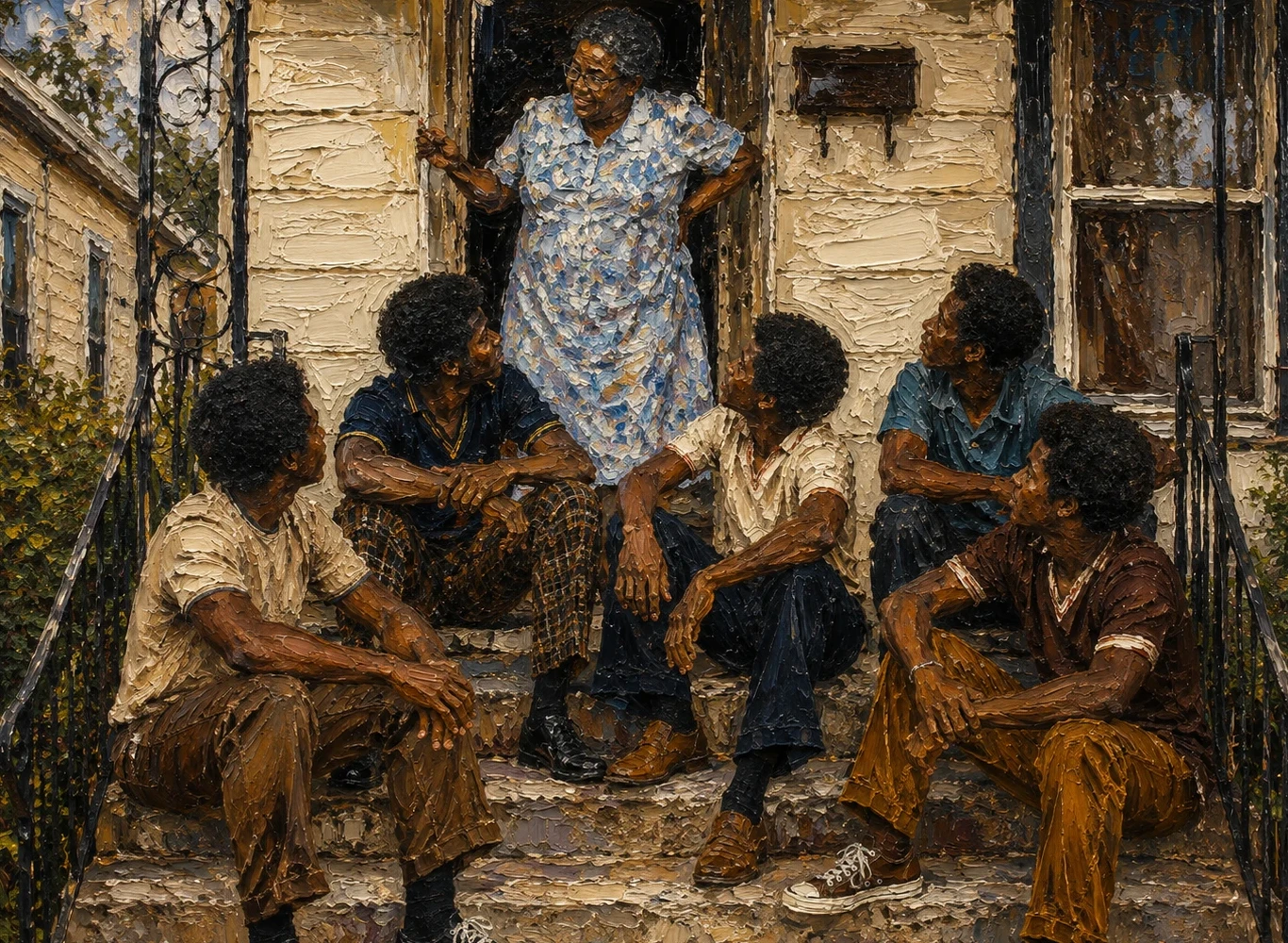
“You all out here having a heavy conversation today,” she said, voice calm but observant.
Larry sat up straighter.
“We just talking, Miss Bernice.”
“Mmm,” she hummed. “Y’all always just talking. And then the next thing I hear, somebody in trouble and somebody’s mama crying in my living room.”
Nobody answered. Miss Bernice didn’t push. She didn’t need to. She handed Earl the glass she’d brought out—water with ice, sweating down the sides like it was been cold a long time.
“Drink,” she said. “You look like you holding something you shouldn’t.”
Earl accepted it, eyes down.
“Thank you.”
Miss Bernice turned her attention to the group as a whole.
“Whatever you thinking,” she said, “I hope you thinking it all the way through.”
Reggie nodded, grateful for her presence. Larry looked away, annoyed that the universe had sent a witness.
Mark spoke carefully.
“We just trying to figure out what we supposed to do.”
Miss Bernice smiled, but it wasn’t a happy smile. It was a smile that came from knowing.
“Baby, if you waiting on somebody to tell you what you supposed to do, you gonna be waiting a long time.”
Isaiah looked up at her.
“Then how we know?”
Miss Bernice leaned against the doorframe.
“You know by what you can live with,” she said. “Not what you can get away with. What you can live with.”
The words landed like stones. She didn’t say “don’t.” She didn’t say “you better not.” She didn’t threaten them with hellfire or police. She spoke to the place inside them that still had to wake up every morning and look in the mirror. Then she turned back inside.
The door creaked shut behind her. For a moment, nobody moved. Earl took a sip of water, ice clinking. He stared at the glass like it contained an answer. Larry rubbed his face.
“Miss Bernice always got something to say.” Mark leaned forward slightly.
“She ain’t wrong, though.” Reggie’s voice softened. “What your cousin talking about, Earl? Like… specifics.”
Earl hesitated again. Then he said it.
“He said there’s a warehouse. Not far. They moving electronics. He got a dude on the inside. Says the door be open a certain time. We go in, grab boxes, get out. Ain’t no guns. Ain’t no violence. Just… take and go.”
Isaiah’s eyes widened.
“That’s still stealing.”
Larry shrugged.
“Man, warehouses got insurance.”
Reggie’s head snapped toward Larry.
“Don’t start with that. That’s how people talk themselves into prison.”
Larry’s mouth tightened.
“So what? We just do nothing?”
Mark stared at the steps, thinking.
“Ain’t no such thing as ‘no violence’ when you doing something like that,” he said slowly. “Violence don’t always start with a gun. Sometimes it start with panic. Somebody show up. Somebody run. Somebody fall. Somebody swing. And then—”
“And then it’s too late,” Reggie finished.
Earl’s hand shook slightly as he set the glass down beside him.
“I don’t want to be that guy,” Earl admitted. “I don’t. But I’m tired of being broke, man. I’m tired of watching my little sister wear shoes with holes in them.”
Isaiah swallowed.
“My brother too,” he whispered. “He act like he don’t care. But he do.”
Larry’s voice got low.
“We could do this and be straight for a minute.”
Reggie looked at him like Larry had slapped him.
“For a minute,” Reggie repeated. “And then what? You gonna do it again when the money gone?”
Larry didn’t answer. Because Reggie was right, and Leon hated that.
Mark leaned back, eyes drifting down the street. A group of kids rode bicycles past, their laughter loud and bright, cutting through the heavy air like sunlight through clouds. For a second, Mark watched them like he was remembering what it felt like to be that free. Then he said quietly,
“There’s other ways.”
Larry scoffed.
“Like what?”
Mark looked back at him. “My uncle been asking me to help him at the shop. He fix cars. He ain’t got nobody reliable.”
Isaiah blinked.
“He paying?”
Mark shrugged.
“A little. But it’s something. And you learn.”
Earl’s eyes lifted. “You never said nothing about that.”
Mark’s mouth tightened.
“Because I didn’t want to sound like I’m better than y’all. Like I got some special thing goin’ on.”
Reggie shook his head.
“That’s not better. That’s just somethin’real. A real way to make some money.”
Larry’s expression shifted—still stubborn, but curious.
“What shop?”
“Over by 34th,” Mark said. “He said he need hands. If I bring somebody with me, maybe he can put them on too. Not everybody at once, but… something.”
Isaiah’s voice was hopeful despite himself.
“I can work.”
Earl looked conflicted.
“But that ain’t quick money.”
Reggie leaned forward, eyes serious.
“Quick money always cost more than it pay.”
Larry stared at Reggie for a long moment. Then he looked away. Because there was a part of him that wanted to be the man his mama could rely on. The kind of man who didn’t make her cry. But there was also a part of him that wanted to feel powerful, just once. To feel like life didn’t get to push him around.
Earl rubbed his hands together, nervous.
“My cousin expecting an answer tonight.”
Mark nodded slowly.
“Then tell him no.”
Earl laughed—a short, sad sound.
“You say it like it’s easy.”
“It ain’t easy. Reggie said. “But it’s simple.”
Isaiah looked between them.
“What if we say no… and we still end up stuck?”
Larry’s eyes flicked toward Isaiah.
“That’s what I’m saying.”
Mark took a deep breath.
“Being stuck ain’t the worst thing,” he said. “Being trapped is. Once you do something like that… you trapped. Even if you don’t get caught, you trapped. You gotta keep looking over your shoulder. You gotta keep lying. You gotta keep—” He paused, searching for words. “You gotta keep becoming somebody you don’t recognize.”
The porch went quiet again. Earl’s eyes watered slightly, and he wiped at them fast, like he was swatting away sweat.
“I don’t want to become that,” he admitted.
Reggie nodded.
“Then don’t.”
Larry’s shoulders sagged. The fight in him softened into exhaustion.
“Man… I just want to breathe,” he confessed. “Like really breathe. Without worrying.”
Isaiah’s voice was small.
“Me too.”
Behind them, the door creaked again. Miss Bernice didn’t come out this time, but her voice carried through the screen, gentle but firm.
“You boys hungry?”
They all looked back. Larry blinked.
“Yes, ma’am.”
Miss Bernice chuckled.
“I figured. I made a pot of beans and some cornbread. Ain’t much, but it’ll hold you.”
Nobody moved at first. Pride tried to rise up—pride that said, “We ain’t charity.” But hunger beat pride. And something else beat it too: the feeling of being seen, cared about, included.
Earl stood first.
“Thank you, Miss Bernice,” he said, voice thick.
The others followed, one by one, filing into the narrow hallway that smelled like clean laundry and onions and home. In the kitchen, Miss Bernice served them like she’d served them when they were younger—big spoons, generous portions, no questions asked. They ate at her table, shoulders touching, elbows bumping, the quiet at first turning into small talk, then into laughter, then into stories about old teachers and dumb fights and the time Larry fell through the ice at the park and pretended he didn’t cry. For a little while, the weight lifted.
After they ate, they went back out to the porch with full stomachs and softer eyes. The sky had shifted. The light was more golden now, leaning toward evening. The street felt calmer. The kids on bikes were gone. A car parked down the block, and a man got out carrying a grocery bag, nodding at them as he passed. Earl sat back down, quieter than before. The water glass was still there, half full. Larry looked at him.
“What you gonna tell your cousin?”
Earl stared at his hands. Then he looked up, eyes clearer.
“I’m gonna tell him we ain’t interested.”
Isaiah exhaled like he’d been holding his breath for an hour. Reggie’s shoulders relaxed. Mark nodded once.
“Good.”
Larry didn’t cheer. He didn’t smile. He just sat with it. The idea of “no” felt like a door closing. But maybe it was also a door opening somewhere else.
Reggie said,
“And tomorrow, we go see your uncle.”
Mark glanced at him.
“You coming too?”
Reggie nodded.
“If he’ll take me.”
Mark smiled a little.
“He’ll take you. He like people who show up on time.”
Larry chuckled.
“Oh, he gonna love Reggie then.”
Reggie rolled his eyes, but it was gentle.
“Shut up.”
Isaiah looked hopeful.
“You think he got room for me?”
Mark nodded.
“We’ll find out.”
Earl picked up the glass and took another sip.
“I don’t know if it’ll be enough,” he admitted. “But… I know stealing ain’t gonna be enough either. It’ll never be enough.”
The words felt like something Miss Bernice might’ve said. But Earl said them himself, and that meant more.
The night started to come in slow. Porch lights flickered on up and down the street like fireflies. The green door behind them looked darker now, almost black in the shadows. They sat there a while longer, talking about tomorrow. Talking about what they could do. Talking about how to help their families without losing themselves. When the conversation dipped into silence, it wasn’t the heavy silence from before. It was a quiet that felt earned.
The steps still creaked. The paint still peeled. The neighborhood still carried its burdens. But on that porch, for that evening, five young men chose something that didn’t feel exciting or flashy or powerful. They chose to stay themselves. They chose the kind of “control” that nobody claps for right away—the control of saying no to the wrong thing, even when the wrong thing is waving money in your face and promising relief. The control of taking a slower road.
As the streetlights glowed and the air cooled, Larry leaned back against the porch post and said quietly, almost to himself,
“Maybe breathing ain’t about having everything.”
Mark looked over at him.
“What you mean?”
Larry shrugged, eyes on the darkening sky.
“Maybe it’s about… not suffocating yourself.”
Reggie nodded.
“Yeah.”
Isaiah smiled a little, like he could finally picture tomorrow. Earl held the glass of water in both hands, feeling the cold on his palms, and for the first time all day, he felt something like peace—not because his problems had disappeared, but because he’d chosen what he could live with.
Inside the house, Miss Bernice washed dishes, humming under her breath, and thinking about when the guys first started hanging out on her steps. They had been young, around seven, or eight, and had run up her steps running from a dog. She had let them in the house, and gave them some Kool-Aid and cookies. They had been coming back ever since then.
Outside, on the porch, the young men sat together as the night came in. And the line Earl had talked about—the line you couldn’t see—shifted a little farther away. Not because life got easier. But because they had stepped back from it, together.