February wind cut through Minneapolis like a blade. It seemed like it came off the frozen Mississippi and ran straight down the avenues, pushing powdery snow across sidewalks in thin silver sheets. The sky was the color of unpolished steel, and everything felt cold — the air, the pavement, even the thoughts in Matt’s head.
The blood was still there in the snow. Right there outside of Wilharm’s Drug Store on the corner of 38th & Chicago Avenue. It had darkened from bright red to a rusty brown, half-soaked into the packed snow and half-frozen into a stiff crust.
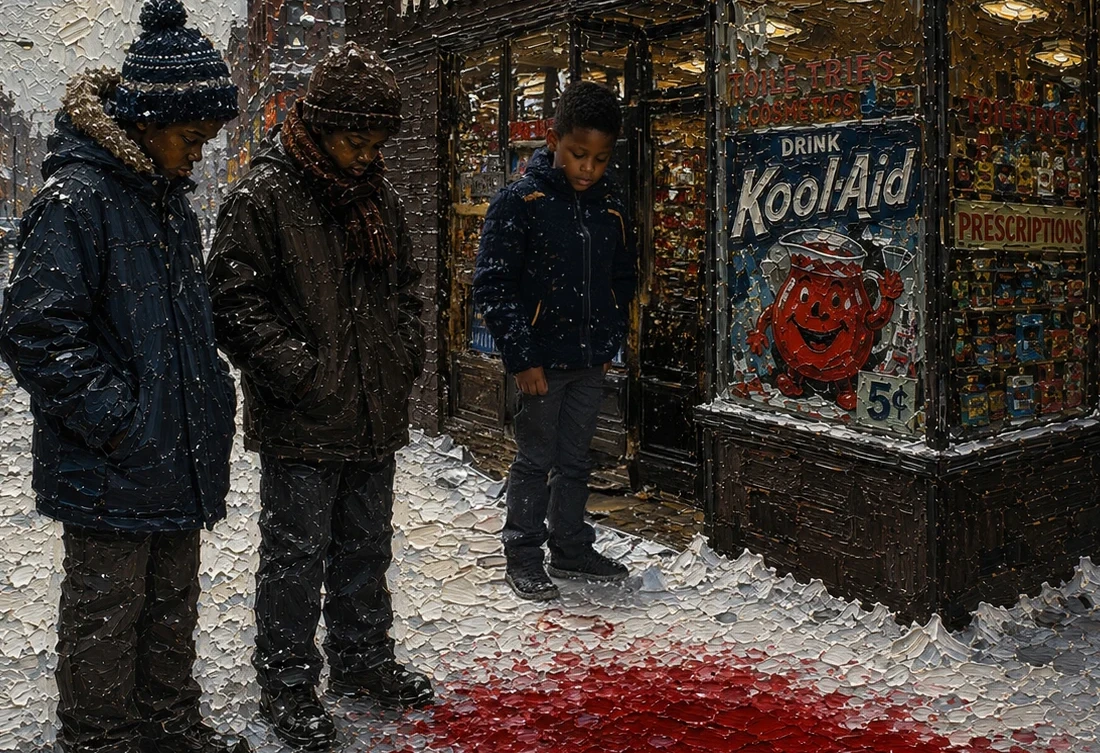
The city had plowed the street. People had walked past it. Cars had rolled by. But no one had shoveled it away. Matt stared at it longer than he meant to. It gave him a funny feeling knowing that the person the blood belonged to was dead.
He had heard the story three different ways already. A man tried to rob Wilharm’s. Late evening. Snow falling heavy. Security guard inside. Gun drawn. Shots fired. Man dead before the ambulance came. Just like that.
“Man, why they ain’t clean that up?” Stu muttered beside him, his breath coming out in white bursts.
A.D. kept his hands shoved deep in his coat pockets.
“Guess they want folks to remember.”
“Remember what?” Matt asked.
“That this ain’t no game.”
They stood there a few seconds longer. Cars moved slowly through the intersection. A bus roared past. A woman with grocery bags hurried by without looking down. Matt swallowed. It had been a week. He wondered about the man. What made him try it? Did he have kids? Did he wake up that morning knowing he’d be dead before midnight? Or was it just another bad decision that turned permanent?
“Come on,” Stu said. “My mama gon’ think we froze solid.”
They kept walking. They had taken the long walk home from Folwell Junior High — down on 37th and 21st Avenue. They usually caught the city bus, but sometimes they walked when the air felt sharp enough to make you feel alive, or when they needed time to think, or when they wanted to spend their bus fare on snacks. Matt’s boots crunched against the snow. His mind was still stuck on the blood.
It bothered him in a way he couldn’t explain. He was thirteen years old. And death had just moved into his neighborhood like it paid rent.
Matt didn’t even want to be going to Folwell. Most of his friends were going to Bryant Junior High. Bryant was right around the corner from his house. He could practically see it from his bedroom window if he leaned far enough. But Bryant had a reputation. A reputation that was well earned. Fights in the hallways. Lockers broken into. Older boys who had already decided school didn’t matter. Matt had begged. Argued. Even cried once.
“I’m not scared,” he had told his father. “That’s not the point,” his father had replied calmly. His mother had stood at the kitchen sink, drying dishes slowly.
“You don’t send your child into fire just because everybody else is walking in,” she had said.
“But all my friends—”
“Your friends aren’t raising you,” his father had cut in. “We are!”
That was the end of that. So now Matt rode a city bus twenty minutes every morning to Folwell.
Folwell only had about sixty Black students out of nearly a thousand. Most of them came from Matt’s neighborhood. Most of them rode the bus. And every day, Matt felt like he was living in between two worlds. Not quite here. Not quite there. —
“You see how them boys look at us?” Stu said as they turned down 4th Avenue.
“They always look at us,” A.D. shrugged.
At Folwell, they were noticed. Not always in a bad way. Just… noticed. Some kids were friendly. Some were curious. Some acted like they were doing them a favor by saying hello. Matt kept his head down most days. He did his work, got decent grades and stayed out of trouble. He felt it though. The difference. He missed Bryant sometimes, even though he had never gone there for school. It wasn’t because it was better, but because it was familiar. At Bryant, he would have blended in. At Folwell, he felt like he was on display.
The next day, when they reached Chicago Avenue again, the wind hit harder. They passed Wilharm’s without stopping this time. But Matt glanced. The blood was still there. A thin layer of new snow had dusted over it, but the blood hadn’t disappeared.
That night, Matt couldn’t stop thinking about it. At dinner, his father talked about work. His mother talked about church announcements. His little sister argued about homework. But Matt’s mind was outside that drugstore.
“You alright?” his father asked finally.
“Yes sir.”
“You sure?”
“Yes sir.”
But he wasn’t.
Later, in his room, he stared out the window at the glow of streetlights reflecting off snow. He imagined the man lying there. He imagined the gunshot. He imagined how fast everything changed. One choice. One moment. Forever different. He shivered. — The day after it happened, talk in the neighborhood spread.
“You hear what happened on 38th? and Chicago” one kid asked.
“Man deserved it,” another said.
“No he didn’t” Someone else said
“I heard he had a gun.”
“He shouldn’t have been robbing nobody.”
Matt stayed quiet. He didn’t disagree, but something about it felt heavier than that. Deserved it? He didn’t know, but dead? Dead was final.
In social studies class this week, Mr. Hanson talked about laws and order, about crime rates in cities across America.
“Communities are shaped by the choices of their citizens,” he said.
Matt wrote that down. Communities are shaped by choices. What shaped a person? What shaped the man outside Wilharm’s?
That Friday, Matt, Stu, and A.D. walked home again. The snow had hardened into icy ridges along the curb. The blood was still there. Less visible now. But not gone.
“I ain’t lookin’ at that,” Stu muttered, but they did.
Something inside Matt shifted.
“Y’all ever think about what makes somebody end up like that?” he asked.
“Like what?” A.D. said. “Dead in the snow?”
Stu kicked at a chunk of ice.
“Probably started with something small.”
Matt nodded slowly. Something small. He thought about Bryant. About the boys who skipped class. About the fights that started over nothing. About the teachers who stopped trying. He thought about how easy it was to drift. He thought about how hard it was to steer.
Saturday morning, Matt’s father knocked on his door.
“Come on,” he said. “Get dressed.”
“Where we going?”
“Just come on.”
They drove past 38th & Chicago. Past Wilharm’s.
Matt looked. The blood was finally gone. A city worker must have shoveled it away. The snow looked clean again. Too clean. His father drove to a church a few blocks away. Inside, in the basement, folding chairs were set up. Coffee in metal urns. Men in work jackets. Women with tired eyes. A meeting. Matt sat beside his father quietly. A woman stood up first.
“We can’t pretend this is normal,” she said.
“Our children are watching.”
An older man followed.
“We need more programs. After-school activities. Mentors. Not just police.” Someone mentioned Bryant. Someone mentioned Central. Someone mentioned jobs. It wasn’t loud. It wasn’t angry. It was tired, and determined. Matt glanced at his father.
“Why we here?” he whispered. “Because this is our neighborhood,” his father replied. “If we don’t care about it, who will?”
After the meeting, Matt thought about that all the way home. — The following week at school, something changed in him. It wasn’t a big, dramatic change, but it was noticeable.
Matt raised his hand more in class. He stayed after school one afternoon to ask Mr. Hanson about history books. He started finishing homework early instead of last minute. Stu noticed.
“You acting different,” he said.
“How?”
“Like you trying to be smart”
Matt shrugged. “Maybe I am.”
He didn’t fully understand it yet. But seeing that blood — seeing what one wrong turn could lead to — had planted something in him. A quiet urgency. A sense that life could tip fast. And that he didn’t want to tip the wrong way.
One afternoon, as they passed Wilharm’s again, Matt stopped. The sidewalk looked ordinary now. Snow packed down by boots. No stains. No evidence, but he remembered.
“I ain’t ever forget that,” he said softly.
“Forget what?” Stu asked.
“That it only takes one bad choice to mess up everything.”
A.D. nodded.
“Yeah.”
The wind picked up again, lifting snow in spirals across the street. Matt looked down Chicago Avenue — long and straight and stretching further than he could see. He didn’t know what his future would be. He didn’t know if his parents were right about Folwell. He didn’t know if Bryant would have made him tougher — or just harder, but he knew this: He was alive. He had choices. And he wasn’t dead in the snow.
By March, the snow began to melt. Dirty piles shrank into gray slush. The city smelled like thawing earth and exhaust. One afternoon, Matt stayed late at Folwell to work on a science project. As he stepped onto the bus afterward, he looked around at the faces — different neighborhoods, different stories. He realized something. Maybe Folwell wasn’t punishment. Maybe it was preparation. Maybe his parents weren’t keeping him from something. Maybe they were steering him toward something.
The bus rumbled past 38th & Chicago. Wilharm’s windows reflected the late winter sun. No blood. No sign of what had happened. Just life moving forward.
Matt rested his head against the cold glass. The world felt fragile. But it also felt open. He didn’t know who he would become, but he knew he didn’t want to be shaped by accident. He wanted to choose. To think. To build. To live in a way that didn’t leave stains in the snow.
When he stepped off the bus near home, he saw Bryant in the distance. Boys laughing near the entrance. Some roughhousing. Some shouting. It looked alive. It looked normal. He watched for a moment. Then he turned toward his house instead. The wind was softer now. The snow thinner. And for the first time since February began, Matt felt something like clarity.
Life was short. Neighborhoods mattered. Choices mattered. Parents worried for a reason. And sometimes, being sent somewhere you didn’t want to go wasn’t about control. It was about love.
As he reached his front door, he glanced once more down the block. No sign of death. Just streetlights flickering on. But Matt would always remember the week when the blood stayed in the snow. And how, in the cold winter of 1971, it forced a thirteen-year-old boy to think about the kind of man he wanted to become.