A Different Feel
The summer of 1974 felt different from the very beginning. Patrick could not have explained exactly why. Maybe it was because he was sixteen now—not a freshman trying to figure out high school, not a sophomore just trying to survive it—but a junior-to be, a varsity hopeful, a young man who had already tasted what it felt like to earn real money. Maybe it was because he had just gotten his drivers license. It gave him a little sense of freedom. Maybe it was because this was his second year in the University of Minnesota Health Careers Program for minority students, or maybe it was because something inside him was slowly waking up—an awareness that life was larger than his neighborhood, larger than football, larger even than the neighborhood streets he knew so well.
Whatever it was, that June morning when he stepped off the number 16A bus near the University of Minnesota’s Minneapolis campus, the air felt full of possibilities. The program had changed his summer the year before. He could still hear Ronnie’s voice from that spring afternoon in 1973 when they had been walking home from school.
A Chance To Make Money
“Man, they pay you five hundred dollars for the summer.” Ronnie had said, leaning back against a stop sign like he was sharing a secret. “Five hundred. That’s good money.”
Five hundred dollars felt like five thousand dollars to a fifteen-year-old kid. Patrick had tried to look unimpressed.
“For real?”
“For real. We work at the U, in their labs, and hospitals, or other departments. You get exposure to careers in the health field. That’s what they call it. Exposure.” Ronnie grinned. “But all I know is that we get paid.”
It hadn’t taken much convincing. Now, one year later, the stipend had gone up. Six hundred and twenty dollars. Patrick had done the math twice when the coordinator announced it at orientation. Six hundred and twenty dollars. That was new Tigers, or Pumas tennis shoes. That was new designer jean’s from Brown’s Department Store downtown. That was helping his mom with groceries and still having money left over for dates. Dates. He shook the thought away and crossed the mall toward the lab building. He wasn’t thinking about that. Not yet.
New Assignment
This summer he had been assigned to the cystic fibrosis lab. The name alone sounded important. The lab was cool and quiet, filled with glass beakers, humming machines, metal tables, and the faint scent of chemicals that seemed to cling to his clothes by the end of each shift. He wasn’t running experiments on his own, of course. Mostly he labeled samples, washed equipment, recorded numbers, carried trays from one room to another, but he paid attention. He listened when the graduate students talked about lung function and genetic disorders. He watched the way the lab supervisor leaned over a microscope, brow furrowed in concentration.
He liked the seriousness of it all. The idea that what they were doing mattered. Some mornings, when the sunlight filtered in through the high windows, dust particles floating like golden specks in the air, Patrick would pause for a second and imagine himself in a white coat, his name stitched above the pocket. Dr. Patrick Williams. It didn’t seem impossible.
Kids From All Over
The program was meant to open doors—to show kids from Minneapolis, St. and Paul, North, South, East, and West—that medicine wasn’t just something other people did. It was for them too. And the program brought them all together. Black kids from North and South Minneapolis. Latino kids from West St. Paul. Native American kids from South Minneapolis, and even a few White kids from lower income areas. A mix of accents, hairstyles, neighborhoods, and slang.
After working in their various departments during the week, the group would gather every Friday for lunch. The would work until noon that day, and then meet in one of the halls for lunch, usually Coffman Union.
During lunch the kids talked about everything—music, basketball, the Twins, the Vikings, which singer, or group had a new record album, who was going to what high school, who had a car, who didn’t. The boys would usually sit at the tables and on one side of the room, and the girls on the other. When one of the organizers asked about it one day, everyone just sort of shrugged their shoulders. No one had even realized the divide.
Lunch would be served in long cafeteria trays: mashed potatoes, chicken, green beans, rolls. After that, there’d be a guest speaker—doctors, nurses, researchers—talking about their path into healthcare. Every other week, paychecks were handed out. Those were the full Fridays. Everyone would be there.
Payday And Non-Payday Fridays
On payday, nobody skipped. The room buzzed louder. Chairs scraped against tile floors. Envelopes changed hands. Some kids opened theirs right there on the spot, holding the check up like it was a golden ticket, and others would wait to deposit it to their bank.
On non-paydays though, attendance sometimes dipped with some of the kids deciding to take the rest of the afternoon off, rather than sit through a lecture and eat cafeteria food. That’s how it happened, but before that day, there were weeks of looking. Weeks of quiet glances. Weeks of twin smiles across a crowded room.
Summer Job Crush
They always arrived together. Lynaya and Danaya. Puerto Rican twin sisters from the Westside of St. Paul. Patrick didn’t know which was older. He wasn’t even sure if they were identical or just very close in appearance. Their thick hair fell in soft, dark waves past their shoulders. Their laughter came easily—bright, musical, contagious. They dressed with a kind of effortless style that made even simple jeans and blouses look intentional.
He noticed that they often sat near the middle of the room on Fridays. Not in the front like the overachievers. Not in the back like the too-cool crowd. Just somewhere balanced. He would catch himself staring and then quickly look away. Ronnie had noticed.
“Busted. You’re checkin’ those twins out again.” Ronnie had whispered one Friday.
“No I’m not.”
“Yeah, you are. You’re not fooling anybody. I know you like ’em.”
Patrick shrugged, trying to act casual.
“They cool.”
Ronnie rolled his eyes.
“Then go talk to them.”
“With everybody around? Man, please.”
Ronnie laughed.
“You scared? Big bad football player, but you’re scared to talk to a couple of girls.”
Patrick shoved him lightly.
“It ain’t the same.” Patrick protested, and it wasn’t. Football had rules. Plays. Pads. A clear objective. Talking to girls—especially girls who seemed as confident and polished as those twins—felt like stepping onto a field with no boundaries. So he watched. And waited.
A Pleasant Surprise
By early August, the rhythm of the program was in full stride, with three weeks left in the program. On that particular Friday it wasn’t a payday. It was a nice day, and summer was winding down, so a number of kids in the program had decided to skip, and start their weekend early.
The room looked half-empty. Some chairs remained stacked against the wall. Conversations echoed differently in the smaller crowd. Ronnie even didn’t show up. “Probably sleeping,” Patrick muttered to himself. Lunch was served. A guest speaker talked about pathology—about the study of disease, about tissue samples and microscopes and the quiet detective work of medicine. Afterward, they were told they’d be touring a pathology lab in one of the buildings across campus.
They walked in a loose group toward the elevator to go down to the main floor. The first elevator doors slid open with a metallic sigh. It filled quickly. Patrick hung back, letting others step in. “I’ll catch the next one.” He thought to himself. That’s when he felt it. A hand around his forearm. Warm. Firm. Unexpected.
“Come on,” a voice said.
He turned. Danaya. Not Lynaya. Danaya. She smiled slightly, tugging him forward just enough.
“There’s room.”
Before he could process it, he was stepping inside. The doors closed. The elevator hummed. And suddenly, the space felt smaller.
He could hear his heartbeat. Too loud. Too obvious. Danaya stood beside him—not directly in front, not behind—just close enough that he could feel the warmth of her shoulder near his arm.
“Do you work in Minneapolis or St. Paul this year?” she asked casually.
“Minneapolis. Cystic fibrosis lab.”
“Oh. That sounds serious.”
He shrugged.
“It is. Kind of.”
She laughed softly.
“I’m at St. Paul campus. Pediatric unit.”
“That’s cool.” Patrick said.
No Guts, No Glory
The elevator dinged. Doors opened. People filed out. But somehow, during the tour of the pathology lab—the sterile white walls, the stainless steel counters, the low hum of refrigeration units—Danaya stayed near him. She asked questions about what he did in his lab. He asked about hers. He found himself relaxing. It wasn’t dramatic. No music swelled. No spotlight hit them. It was just conversation—easy and unforced. But for Patrick, it felt monumental. Because this was his last week. Not only his last week, it was his last day in the program.
Football practice started early in August with Two-a-days, pads, running, and heat. Coach didn’t care about summer programs. He cared about you being at practice, if you planned to be on the team.
Patrick liked this girl from the Westside of St. Paul, and he knew that if he didn’t say something now, he’d never see her again.
The tour ended. They stood in the hallway near the elevators again. People were drifting off in small groups. He could feel the moment slipping.
“Hey,” he said, his voice slightly rough. She looked at him.
“Yeah?”
“I, uh… I’m finishing up this week. This is my last day. Football’s starting on Monday.”
“Oh. That’s cool. You look like a football player.”
Patrick smiled.
“Yeah, but… I was wondering…” Just say it. “…if I could get your number, and maybe call you sometime.”
There it was. No turning back. For a split second, he wondered if he’d misread everything. Then she smiled. A slow, knowing smile.
“Sure. I’d like that”
She reached into her purse, pulled out a small piece of paper, and wrote it down. Her handwriting curved neatly across the page. She handed it to him.
“Make sure you call me.” She said looking him in the eye and smiling.
“I will.” And he meant it.
The First Call
He stared at the paper all Saturday morning. The numbers looked fragile, like they might fade if he touched them too much. Finally, around three in the afternoon, he picked up the phone in his living room. His mom was in the kitchen. The television hummed softly. He dialed. It rang. Once. Twice. Three times.
“Hello?” Her voice.
“Hey… is this Danaya?”
“Yes?”
“It’s Patrick. From the program.”
A small pause.
“Oh! Hey. How are you?”
Relief washed over him. They talked for twenty minutes. About school. About football. About West St. Paul. About music. When he hung up, he leaned back against the couch and grinned. He had done it.
A Compromise
West St. Paul felt far from Minneapolis. Different buses. Different routes. Different worlds. So they compromised. They met downtown. Sometimes in downtown Minneapolis—walking along Nicollet Mall, Hennepin Avenue, passing storefronts, listening to street musicians.
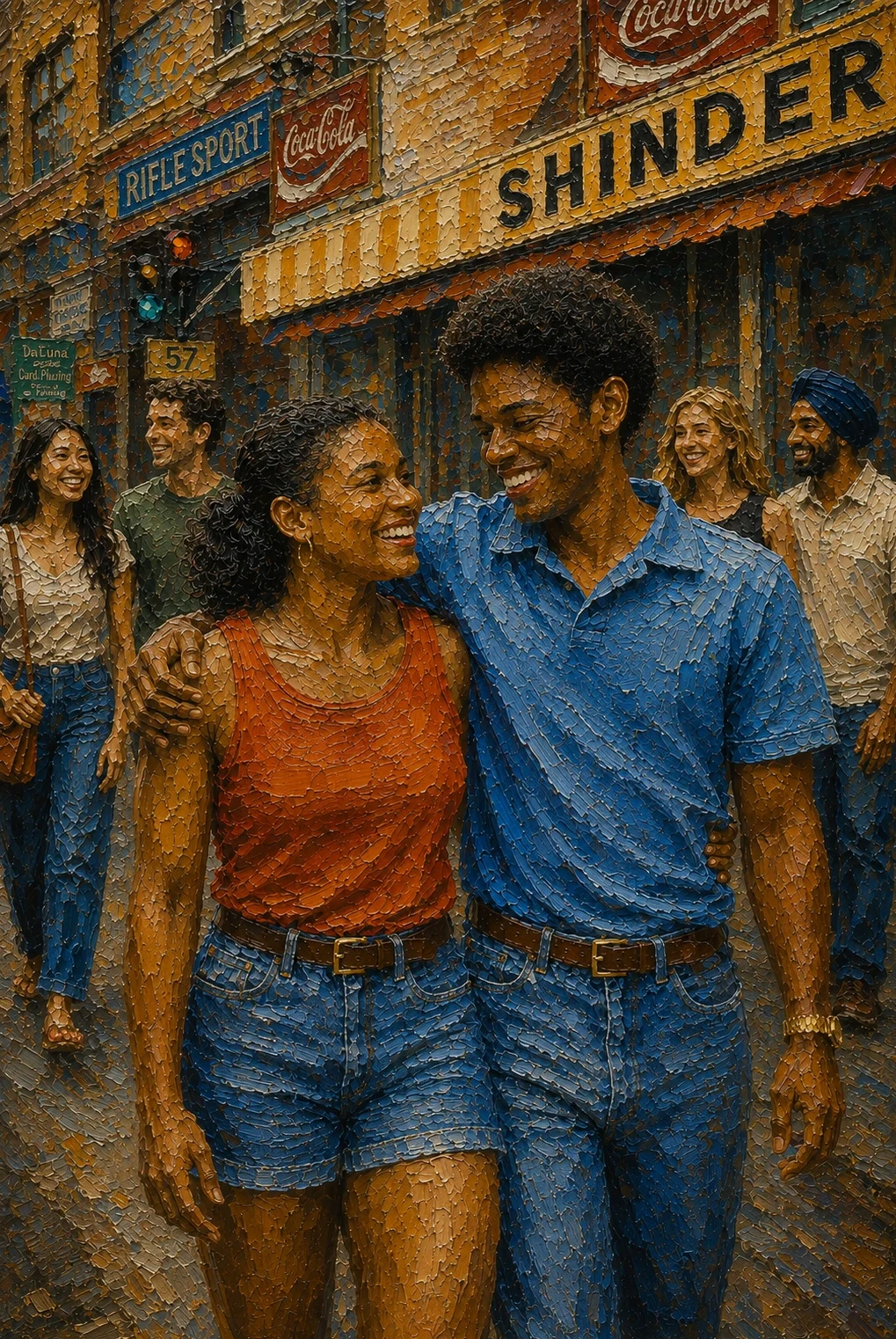
Sometimes in downtown St. Paul—quieter, older buildings, a different rhythm. They went to movies at theaters with velvet seats and sticky floors. They shared popcorn. They walked without always knowing where they were going. Once, they met at Como Zoo. They wandered past the giraffes, the monkeys, the big cats pacing behind glass. She laughed when the sea lions barked. He tried to act unimpressed but couldn’t hide his smile.
It wasn’t flashy. No one had a car. No expensive restaurants. Just bus tokens, sneakers, summer air, and time. He liked that she didn’t make him feel small. She liked that he listened. Sometimes Lynaya came along, in the beginning, but gradually it became just the two of them. Not officially. Not labeled. Just something unfolding.
Conversations At Summer’s End
August evenings carried a golden hue. The sun lingered longer. They would sit on benches and talk about the future.
“What do you want to do?” she asked one night.
“Maybe medicine,” he said. “Or maybe football. I don’t know yet.”
“You could do both.”
He laughed. “That’s not how it works.” He laughed.
“Why not?”
She had a way of asking questions that made him reconsider what he assumed was fixed.
“What about you?” he asked.
“Maybe nursing,” she said. “Or maybe teaching. I just know I don’t want to stay stuck.”
“Stuck where?”
“Anywhere.”
He understood that. Even if he couldn’t articulate it. They were sixteen. But they were already thinking about escape and opportunity. About becoming something more.
The Acknowledgement
Football was over and winter arrived. By the time the cold really settled in, Patrick and Danaya had stopped pretending they were just friends who happened to meet downtown. Somewhere between the walks along Nicollet Mall, the movie matinees, the long bus rides home, and the afternoons spent wandering places like Como Zoo or Rice Park, something had quietly taken shape between them. Neither one had made a formal speech about it, but the understanding was there. When Patrick introduced her to some friends one afternoon outside a theater downtown on Seventh Street, he had said simply, “This is my girl, Danaya.” Danaya had smiled but hadn’t corrected him. After that, the word girlfriend began to slip naturally into conversations.
They talked on the phone several nights a week when they could manage it. Sometimes the calls stretched long enough that Patrick’s mother would poke her head into the living room and say, “You still on that phone?” “Almost done,” he’d say, though he never was.
Adjusting To The Cold
They talked about school assignments, friends, basketball games, music and plans for the future. There was comfort in the rhythm of it. Something steady. Something real. Even when the cold weather started, they tried not to let it change things. They still met downtown when they could. It was harder now. Bus stops were colder. The days were shorter. Sometimes Patrick stood waiting in the wind off the river, collar pulled tight around his neck, watching his breath rise in white clouds while he waited for her bus to arrive.
When she would step off the bus and see him, smiling despite the cold, it always felt worth it. They would duck into warm places—department stores, diners, coffee shops—anywhere they could sit and talk. Sometimes they didn’t even do much talking. Just being together felt enough. Patrick had begun to imagine spring. Warmer days. Longer walks. More time together. For now though, they would meet when they could, but the phone calls were now more frequent.
He didn’t know that winter had already decided something else.
Winter Sadness
It was one of the coldest days of the year when she told him. The temperature had dropped into the single digits, and the wind cut through coats like thin blades. Patrick stamped his feet outside the building near Wabasha Street where they usually met, trying to keep warm while he waited. When Danaya finally arrived, something felt off right away. She walked toward him more slowly than usual. Her smile didn’t come right away. Her eyes looked uncertain.
“Hey,” he said, leaning forward to hug her.
She hugged him back, but only for a moment.
“Hey.”
They stepped inside the building to get out of the cold. The warmth hit them immediately, fogging Patrick’s glasses for a second. They stood near the wall where people passed by with shopping bags and winter coats dusted with snow.
“You okay?” he asked. She nodded, but the motion looked forced.
“Yeah.”
He waited. She didn’t speak. Finally she took a breath.
“Patrick… I need to tell you something.”
His stomach tightened.
“What?”
She looked down at her gloves.
“My parents… they found out.”
“Found out what?”
Her eyes lifted slowly.
“About us.” The words hung between them.
“Oh.” He didn’t know what else to say. “They didn’t know before?”
She shook her head.
“They suspected. But they didn’t know for sure.”
“And now they do?”
She nodded again.
“And they’re… not happy. about me seeing you.”
Patrick felt the warmth of the building fade a little.
“What they say?”
She swallowed.
“They said I can’t see you anymore.”
The sentence landed softly but heavily, like snow falling onto already frozen ground.
He stared at her.
Danaya continued.
“They said… no dating…..until we turn eighteen. Lynaya and me.”
Patrick blinked.
“Eighteen?”
She nodded.
“They said we don’t need distractions. They want us focused on school. On our grades. On college.”
He shook his head slowly.
“That’s… two years. Are you serious?”
Tears glistened in her eyes now.
“I argued with them.” “I know you did.” “Me and Lynaya both did. They told both of us the same thing.”
He leaned back against the wall.
“And that’s it?”
“They won’t change their minds.”
“No way around it?”
She shook her head.
“They were firm.” Her voice trembled slightly. “They said if we keep seeing you anyway, they’ll take away everything. No going out. No phone in our room. Nothing.”
Patrick rubbed his hands together slowly. It felt unreal. Like something temporary. Like maybe if he waited a minute the conversation would reset. Her eyes met his. Silence stretched between them. People walked past. Boots squeaked against wet tile. Coats rustled. The world kept moving. Patrick stood still.
A tear slipped down her cheek.
“I’m sorry.”
He nodded once, slowly.
“It ain’t your fault.”
“I wish it was different.”
“Yeah.”
They stood there, neither moving. Finally he said quietly:
“So this it?”
She hesitated. Then nodded.
“For now.”
The words lingered.
“For now.”
Not forever. But not now. And now was all they had ever really known. They walked together toward the bus stop anyway. Neither one wanted to be the first to leave. The cold hit them again as soon as they stepped outside. It felt sharper than before.
More final.
They stood under the shelter while snow drifted sideways through the air.
“I meant what I said,” she told him softly.
“What?”
“I didn’t want this.”
“I know.”
“And it’s not because of you.”
“I know.”
The End
They stood shoulder to shoulder. Close but not touching. After a moment she slipped her hand into his. Just like always. For the last time. The bus came sooner than he expected. It always did when you wanted time to slow down. She turned toward him.
“I’m glad I met you.”
He nodded.
“Me too.” She leaned forward and hugged him tightly. Longer than usual. As if memorizing the moment. He could feel her tears on his cheek. Then she stepped back. Climbed the bus steps. Turned once more. And waved. Patrick raised his hand. The doors closed. The bus pulled away into the gray winter afternoon.
Patrick stood there a long time after it was gone. The cold eventually forced him to move. He walked slowly toward his own bus stop. Hands in pockets. Head down.
The city moved around him the same as always—cars rolling through intersections, people hurrying along sidewalks, snow crunching underfoot. But something had changed. Not dramatically. Not loudly. Just quietly. Like a door closing somewhere far behind him.
Reflection
That night he sat at the kitchen table long after everyone else had gone to bed. He thought about the elevator that summer. About the way she had grabbed his arm and said, “Come on.” About how everything had started with something so small. He wondered what eighteen would look like. It felt far away. But not impossible. As hard as the day had been, one thought stayed with him.
They hadn’t stopped because they wanted to. They had stopped because life sometimes draws lines you can’t cross yet.
Not yet.
And somehow that made it easier to believe that some stories don’t really end. Sometimes they just pause. Waiting for time to catch up.